Things to do in Warsaw
Things to Do in Warsaw
The sights that make Warsaw worth two or three days, from the rebuilt Old Town and the Royal Route to POLIN, Lazienki Park and the Vistula riverfront.
By ViewPoland Editorial
5 min read
Updated July 2026
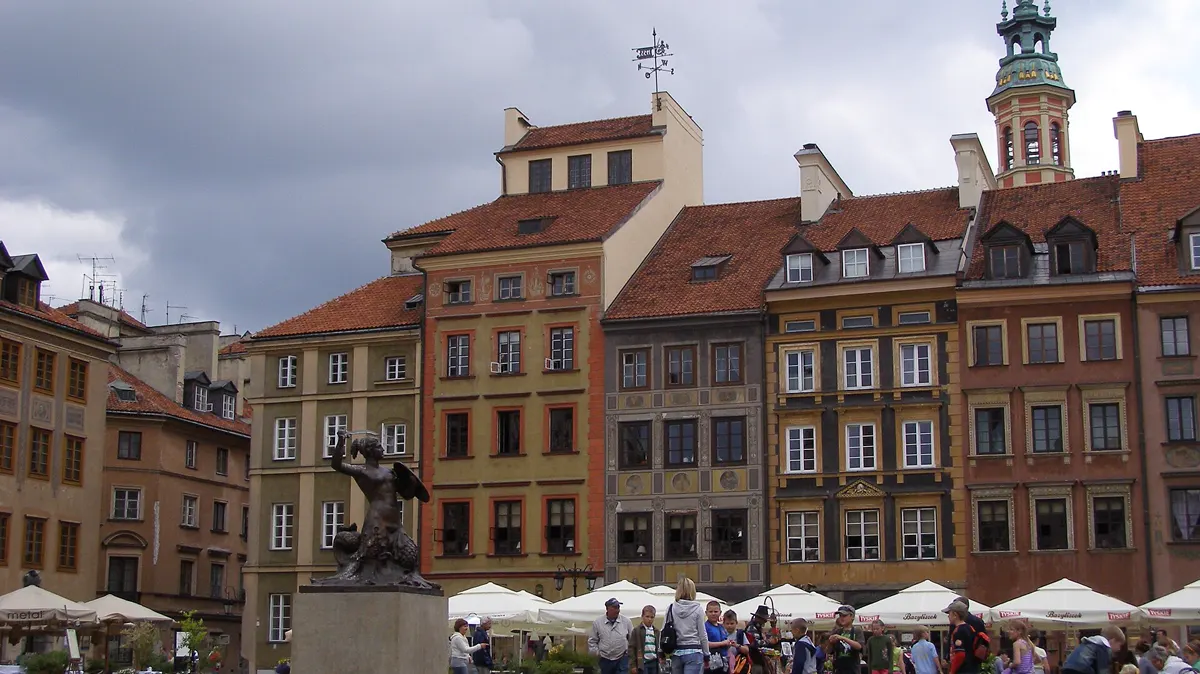
Warsaw catches out people who expect a grey capital. The city was flattened in 1944 and rebuilt afterwards from photographs and paintings, so its Old Town is a careful reconstruction rather than a survivor. Around it sit Stalinist towers, glass office blocks and a long stretch of green parks and river beach along the Vistula. Two or three days covers the main sights without a rush. This guide groups them by area and theme so you can plan short walking routes rather than crossing the city again and again. For wider background, opening hours and where to base yourself, start with the Warsaw destination guide.
Start in the Old Town and Castle Square
The Old Town Market Square is the obvious first stop, ringed by tall merchant houses in mint, ochre and dusty pink. None of it is medieval fabric. The whole quarter was rebuilt between 1949 and the 1960s and later listed by UNESCO in 1980, specifically as an example of near-total reconstruction. Walk in through the red-brick Barbican, a fortified gate first built around 1540 and rebuilt after the war from salvaged brick.
On the south side stands Castle Square with Sigismund's Column, raised in 1644 and the oldest secular monument in the city. The square is dominated by the Royal Castle, rebuilt in the 1970s and 1980s and now a museum. Its collection includes two Rembrandts and the Warsaw views by Bernardo Bellotto, the paintings that guided the postwar rebuilding. Nearby, St John's Archcathedral and the small Mermaid statue, the city's emblem, round out the quarter.
Walk the Royal Route
From Castle Square the Royal Route runs south, the grandest street in the city. It starts as Krakowskie Przedmiescie, lined with churches, palaces and the University of Warsaw, then becomes Nowy Swiat, a shopping street full of cafes.
Two stops reward a short detour. Chopin's heart is sealed in a pillar of the Holy Cross Church, brought back from Paris after his death in 1849. A block away, the University Library roof garden is one of the largest rooftop gardens in Europe and free to walk, with views over the river.
Warsaw Uprising Museum and wartime history
Warsaw's hardest history is also its most rewarding to visit. The Warsaw Uprising Museum, opened in 2004, tells the story of the 1944 revolt against German occupation through recordings, weapons and a replica bomber. Allow at least two hours and expect crowds at weekends.
In the former ghetto district, the POLIN Museum of the History of Polish Jews opened its core exhibition in 2014 and traces a thousand years of Jewish life in Poland, not only its destruction. Outside stands the Ghetto Heroes Monument, and a few streets away the Nozyk Synagogue is the only prewar synagogue in the city still standing. Back in the centre, the Tomb of the Unknown Soldier keeps a changing of the guard on the hour.
Lazienki Park and the Warsaw palaces
Lazienki Park is the green heart of the city, built around the neoclassical Palace on the Isle. From mid-May to late September, free Chopin piano concerts are held here on Sundays at noon and 4pm beside the Chopin Monument, a fixture since 1959. Check the current dates on the park's official site before you go, as the season shifts slightly each year.
For a full baroque palace, take a bus or a longer walk south to Wilanow Palace, sometimes called the Polish Versailles. It survived the war largely intact, which makes it a rare original among Warsaw's landmarks, and its formal gardens are worth as much time as the interior.
Look at modern Warsaw and the river
The Palace of Culture and Science is impossible to miss, a 237 metre Stalinist tower given to the city by the Soviet Union in 1955. Locals have a complicated relationship with it, but the viewing terrace on the thirtieth floor gives the widest view over Warsaw. For families, the Copernicus Science Centre on the riverbank is one of the best hands-on museums in the country.
In summer the action moves to the water. The Vistula Boulevards fill with bars and cyclists, and free ferries cross to the wild eastern bank. That side is Praga, the district that escaped wartime destruction, now full of courtyards, galleries and the Neon Museum of salvaged communist-era signs.
How long do you need, and getting around
Two days covers the Old Town, the Royal Route and one big museum. A third day lets you add Wilanow or Praga at a slower pace. The centre is walkable, and a clean metro, tram and bus network reaches everything else on a single ticket. For fares, apps and airport transfers, see the guide to getting around Poland.
Good to know
Several major museums keep one free-entry day each week, but the day changes by museum and year, so check each official site rather than a blog. If you are choosing between the two big cities, the Krakow or Warsaw comparison weighs them side by side.
Written by ViewPoland Editorial for ViewPoland, an independent English-language guide to Poland. Published 24 July 2026. Last updated 24 July 2026.
Frequently asked questions
Two days cover the Old Town, the Royal Route and one major museum such as POLIN or the Warsaw Uprising Museum. A third day adds Wilanow Palace or the Praga district without rushing.
Yes. It pairs a UNESCO-listed rebuilt Old Town with some of the best history museums in Central Europe, large green parks and a lively riverfront, and it is cheaper and less crowded than many Western European capitals.
No. The Old Town was destroyed in 1944 and rebuilt from the late 1940s using old paintings and photographs. UNESCO listed it in 1980 precisely as an outstanding example of near-total reconstruction.
The historic centre and the Royal Route are easily walked. For Wilanow Palace, Lazienki Park and Praga you will want a tram, bus or the metro, all covered by one ticket.
Walk the Old Town and the Vistula Boulevards, visit the University Library roof garden, and in summer catch the free Sunday Chopin concerts in Lazienki Park. Several museums also have a weekly free day.
Krakow has the more intact medieval old town and easier day trips, while Warsaw offers stronger modern museums and a bigger-city feel. Many visitors do both, as fast trains link them in about two and a half hours.