Itinerary in Warsaw
2 Days in Warsaw
A practical two-day Warsaw itinerary that pairs the rebuilt Old Town and Royal Route on day one with parks, a palace or Praga, a high terrace and the Vistula on day two.
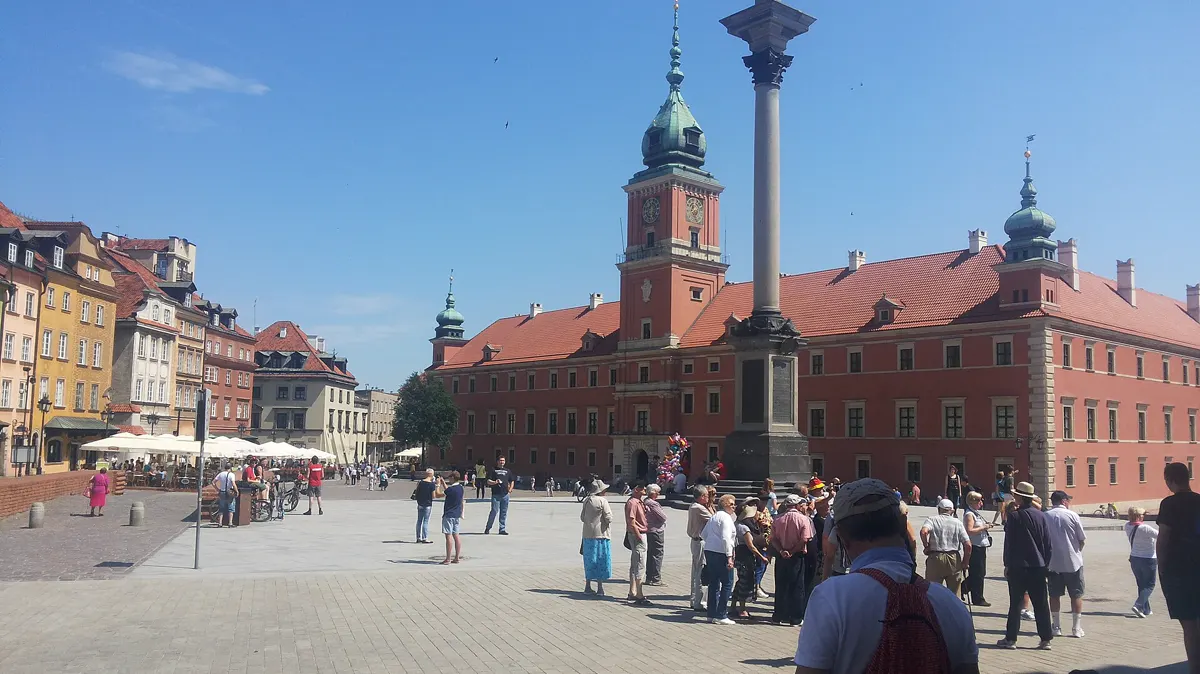
Two days in Warsaw is enough to pair the rebuilt Old Town with the parks and palaces to its south, as long as you group sights by district and keep the walking tight. This plan gives you a compact first day around the historic core and the Royal Route, then a greener second day of gardens, one big palace or the Praga district, a high terrace and the riverside. For the wider list of options, see our full guide to things to do in Warsaw.
Day 1 morning: Old Town and Castle Square
Start in the Stare Miasto, the historic core that was flattened in 1944 and rebuilt so faithfully that UNESCO listed it as World Heritage in 1980. Give it around 90 minutes on foot.
Begin at Castle Square and Sigismund's Column, raised in 1644 and the oldest secular monument in the city. From there step into the Royal Castle, the former seat of Polish kings and parliament, reconstructed in the 1970s and 1980s. Book the interiors online if you want the state rooms and the Rembrandt paintings, and check the official site for current hours.
Walk on to the Old Town Market Square and the small mermaid statue at its centre. Loop north to the Warsaw Barbican, the brick gate in the old walls, before turning back south.
Day 1 midday: the Royal Route
The Royal Route runs south from Castle Square and links most of Warsaw's grand addresses in a single straight line, so it doubles as your lunch corridor. Allow an hour of slow walking plus a stop to eat.
The first stretch is Krakowskie Przedmiescie, past the Presidential Palace and the University of Warsaw. Look inside Holy Cross Church, where an urn holding Chopin's heart is set into a pillar. The street then becomes Nowy Swiat, lined with cafes and good for a break.
For a sit-down Polish lunch near the walls, Restauracja Podwale 25 does pork knuckle and pierogi, while Zapiecek is a reliable pierogi chain if you want something quick.
Day 1 afternoon: one big museum
Spend the rest of the day on a single major museum rather than trying to cram in two. Both below need two to three hours and are worth pre-booking a timed slot on their official sites.
The POLIN Museum of the History of Polish Jews, whose core exhibition opened in 2014, traces a thousand years of Jewish life in Poland and stands next to the Ghetto Heroes Monument. The alternative is the Muzeum Powstania Warszawskiego, open since 2004, which covers the 1944 Warsaw Uprising through recordings, weapons and a full-size replica bomber. Pick one by mood: social history at POLIN, wartime history at the Uprising Museum.
Day 2 morning: Lazienki Park and a palace
Open day two with green space south of the centre. Lazienki Park is free to enter and holds the Palace on the Isle, resident peacocks and the large Chopin monument, where free open-air piano recitals run on Sunday afternoons in summer. Two hours is comfortable.
From here you have a choice. Ride south to the baroque Palac w Wilanowie, a royal summer residence from the late 1600s that survived the war largely intact, with formal gardens behind it. Or cross the river to the Praga district, older and grittier, for the Neon Museum and post-industrial courtyards. Wilanow suits garden and palace lovers; Praga suits anyone after street life and design.
Day 2 afternoon: high terrace and the Vistula
Close with a wide view, then the water. Head to the Palac Kultury i Nauki, the 1955 tower that was Poland's tallest building until Varso Tower overtook it in 2022, and ride up to the observation terrace on the 30th floor for a full sweep of the city grid.
Then walk down to the Vistula Boulevards on the left bank, busiest at sunset, with cafes and river views back toward the Old Town. Round off with a drink at a riverside bar such as Cud nad Wisla before dinner.
Good to know
Warsaw is spread out, so buy a 24-hour or 72-hour public transport ticket that covers trams, buses and the metro rather than paying per ride. The same ticket works on all three. For the practical rundown across the country, see our guide to getting around Poland.
Written by ViewPoland Editorial for ViewPoland, an independent English-language guide to Poland. Published 24 July 2026. Last updated 24 July 2026.