The complete guide · Lower Silesia
Wrocław
A city of islands and bridges on the Oder, with a colourful market square, a long German and Polish history and a famous cast of bronze dwarfs.
Overview
Wroclaw is the capital of Lower Silesia (Dolny Slask) and Poland's third-largest city, spread across the Oder (Odra) river and its channels on a web of 12 islands linked by more than 100 bridges. The historic core sits on the west bank, but the oldest quarter, Ostrow Tumski (Cathedral Island), stands slightly upstream, where a lamplighter still lights around 100 gas lamps by hand each evening.
The city changed hands and identities repeatedly: it grew as a Bohemian and Habsburg town, spent centuries as Prussian and German Breslau, and was rebuilt after 1945 when much of it lay in ruins and its population was almost entirely replaced by Poles resettled from Lwow. That layered past shows in the Gothic brick churches, the Baroque university, and the reconstructed Rynek, one of the largest medieval market squares in Europe at roughly 3.7 hectares.
Two things fix Wroclaw in visitors' memories: the Panorama Raclawicka, a 114-metre circular painting from 1894, and the krasnale, hundreds of small bronze dwarfs bolted to pavements, walls, and lamp posts across the centre. Add the UNESCO-listed Hala Stulecia (Centennial Hall) with its multimedia fountain, a serious student population, and a compact, walkable core, and you have a city that rewards two or three unhurried days.
Wrocław at a glance
Airport
Copernicus Airport (WRO), about 10 km southwest of the centre
Population
Around 674,000 in the city, roughly 1.25 million in the metro area
Founded
First recorded around the year 1000; city rights granted in the 13th century
Good to know
The Rynek, Ostrow Tumski gas lamps, and the hunt for the bronze krasnale (dwarfs)
Currency
Polish zloty (PLN, zl). Not the euro.
Language
Polish. English is widely spoken in tourism and by younger people.
Time zone
Central European Time (UTC+1, or UTC+2 in summer).
Emergency
112 from any phone, free, English-speaking operators.
Tap water
Safe to drink everywhere in Poland.
Cards
Contactless is accepted almost everywhere, even for small amounts.
Sockets
Type E, 230V. UK and US visitors need an adapter.
Visas
Poland is in the Schengen Area and uses the EU entry rules.
Top things to see in Wrocław
Market Square
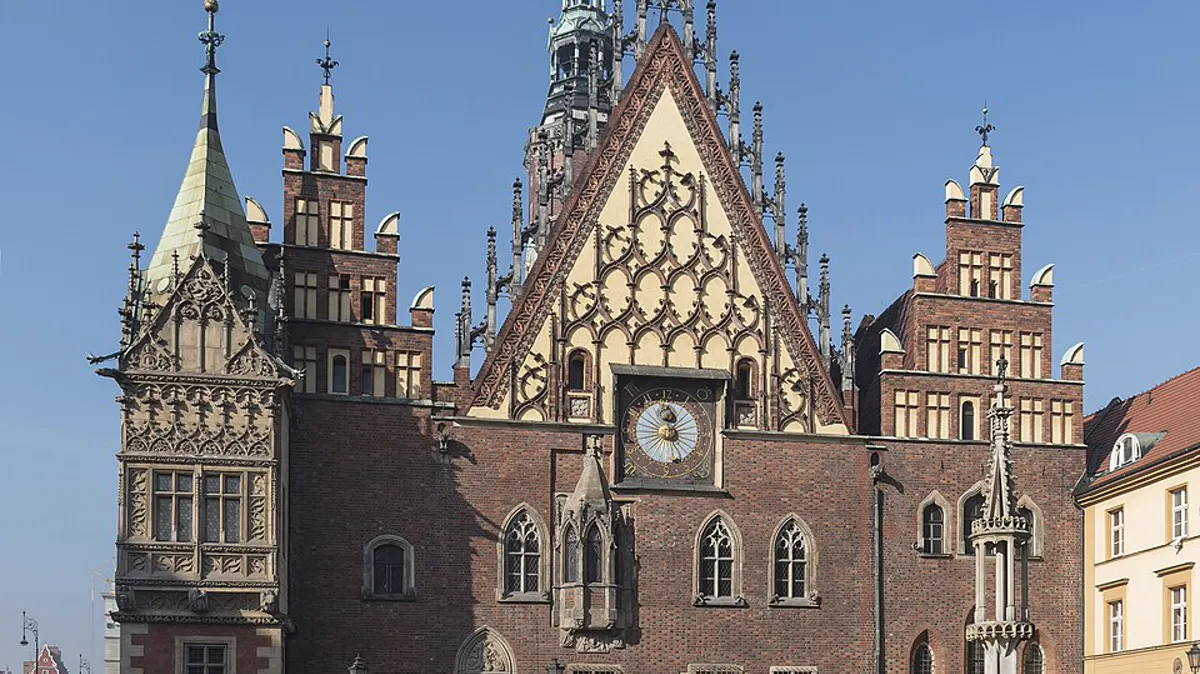
One of the largest medieval squares in Poland, ringed by colourful townhouses and centred on an ornate Gothic town hall.
Ratusz (Old Town Hall)
A late-Gothic town hall built over roughly 250 years, famed for its richly carved south facade and astronomical clock from 1580. It houses the Museum...
Panorama Raclawicka
A monumental 360-degree painting measuring 15 by 114 metres depicting the 1794 Battle of Raclawice. Viewers stand on a central platform as the painted...
Cathedral Island, Wroclaw
The oldest part of Wroclaw, a cluster of churches on an island in the Oder reached across a romantic iron bridge.
Centennial Hall
A pioneering reinforced-concrete dome from 1913, listed by UNESCO, set in a park with a large multimedia fountain.
Ogrod Japonski
A tranquil Japanese garden created for the 1913 World Exposition beside Szczytnicki Park, with ponds, bridges and a small waterfall. It was faithfully...
Hydropolis
An interactive science centre devoted entirely to water, set inside a restored 19th-century underground water reservoir. Highlights include a full-sca...
Wroclawskie krasnale
Hundreds of small bronze dwarf figurines scattered across the city, each with its own character and pose. They trace back to the 1980s Orange Alternat...
Most Tumski i Wyspa Slodowa
A green-painted iron footbridge from 1889 linking Ostrow Tumski, its railings covered in couples' love padlocks. Nearby Wyspa Slodowa is a riverside i...
Museums, castles and nature in Wrocław
Parks and nature
Szczytnicki Park & Japanese Garden
A large landscape park beside the Centennial Hall, home to a jewel-like Japanese garden.
Where to base yourself: the neighbourhoods
Stare Miasto (Old Town)
The walkable heart, built around the vast Rynek with its Gothic Old Town Hall and the smaller Plac Solny (Salt Square). Most sights, the market square cafes, and the krasnale trail sit within a 15-minute walk here.
Ostrow Tumski (Cathedral Island)
The city's oldest quarter, home to the twin-towered Cathedral of St John the Baptist and a cluster of Gothic churches reached over Most Tumski (Cathedral Bridge). It is the one place where a lamplighter still lights the gas lamps by hand at dusk.
Nadodrze
A former working-class district north of the river, now the arts and design quarter, with restored tenement courtyards, independent studios, and cafes along ulica Lokietka and ulica Jagiellonczyka. Less polished than the Rynek and better for street art and local life.
Srodmiescie / Olbin
The dense residential ring around the core, mixing 19th-century apartment blocks with green space at Park Szczytnicki. Convenient bases here put you a short tram ride from both the Old Town and Hala Stulecia.
Wielka Wyspa (Big Island) and Hala Stulecia
The eastern parkland district holding the UNESCO-listed Centennial Hall, the Pergola with its multimedia fountain, the ZOO with Afrykarium, and the Japanese Garden. A tram or a riverside walk brings you from the centre in about 20 minutes.
Przedmiescie Olawskie / Krzyki
The southern neighbourhoods, from the redeveloped riverside near Hala Targowa toward the leafy villa streets of Krzyki. Good for markets, everyday restaurants, and a look at residential Wroclaw away from the tourist core.
How to spend one, two or three days in Wrocław
Day 1
The Rynek, the dwarfs, and Panorama Raclawicka
- Morning: Start on the Rynek, walk around the Old Town Hall and its astronomical clock, then cross to Plac Solny. Climb the tower of St Elizabeth's Church (Kosciol sw. Elzbiety) for a rooftop view over the square, and begin spotting krasnale as you go.
- Afternoon: Visit the Panorama Raclawicka, the 114-metre rotunda painting of the 1794 battle; timed tickets are strongly advised. Afterwards walk to the University of Wroclaw to see the Baroque Aula Leopoldina and the Mathematical Tower.
- Evening: Have dinner near the Rynek, then wander to the illuminated Old Town Hall and finish with a drink in one of the cellar bars off the square, such as Piwnica Swidnicka's neighbours around Kurzy Targ.
Day 2
Ostrow Tumski, Nadodrze, and the river
- Morning: Cross to Ostrow Tumski and visit the Cathedral of St John the Baptist, climbing the tower by lift for the panorama. Explore the quiet lanes and the Church of the Holy Cross, then cross the water toward the Botanical Garden.
- Afternoon: Head into Nadodrze on foot or by tram to see the courtyard murals, design studios, and cafes around ulica Lokietka. Stop at Hala Targowa, the 1908 covered market, for a snack among the food stalls.
- Evening: Take a river cruise or walk the Bulwar riverside at sunset, then return to the centre for dinner. If you time it right, catch the lamplighter lighting the gas lamps on Ostrow Tumski around dusk.
Day 3
Hala Stulecia, the fountain, and the ZOO
- Morning: Tram out to the Wielka Wyspa to see Hala Stulecia (Centennial Hall), Max Berg's 1913 reinforced-concrete dome and a UNESCO World Heritage Site, with its exhibition on the building's history. Walk through the Pergola and the surrounding park.
- Afternoon: Spend a few hours at the ZOO Wroclaw and its Afrykarium, the large aquarium themed on African waters, or relax in the Japanese Garden nearby. In summer, check the schedule for the multimedia fountain shows at the Pergola.
- Evening: Return to the Old Town for a final dinner. Pick up regional treats such as Slaskie kluski or a slice of makowiec, and toast the trip on the Rynek.
Where to eat and drink in Wrocław
Start with what the region does best: Slaskie kluski (Silesian dumplings), Rolada slaska (Silesian beef roulade), Pierogi and Żurek.
Jadka
An elegant fine-dining room under gothic vaults just off the Rynek, a special-occasion staple.
Konspira
A themed restaurant on Solny Square recalling the Solidarity underground, with solid Polish home cooking.
Kurna Chata
A rustic timber room near the Market Square doing filling regional dishes.
Bar Mis
A classic milk bar (bar mleczny) serving cafeteria-style Polish staples such as pierogi, nalesniki, and soups at very low prices. Cash-friendly and po...
Vega
A long-running vegetarian bistro on the Rynek offering meat-free Polish and international dishes at modest prices. A handy central option for plant-ba...
Hala Targowa
The 1908 covered market near Ostrow Tumski, packed with stalls selling fresh produce, cheeses, baked goods, and quick bites. The best spot to graze an...
Charlotte Chleb i Wino
A French-style bakery and wine bar in Wroclaw's Four Denominations District known for fresh croissants, tartines, and all-day breakfast plates. A few...
Kawiarnia Barbara
A bright city-run cafe and cultural space on Swidnicka serving speciality coffee, cakes, and light lunches. A calm break just off the main shopping st...
Restauracja Pod Fredra
An elegant restaurant on the Rynek serving contemporary Polish and international dishes with square views. Good for a special occasion.
Where to stay in Wrocław
Hotel Monopol
A grand Art Nouveau hotel by the opera with a rooftop terrace over the old town and a spa pool.
PURO Wroclaw Stare Miasto
A design hotel steps from the Market Square with a buzzy ground-floor bar.
The Bridge Wroclaw MGallery
A design-led five-star hotel on Ostrow Tumski overlooking the Oder and the cathedral, with a spa and river-view rooms. One of the most atmospheric hig...
Hotel Europeum
A comfortable mid-range hotel a couple of minutes from the Rynek, with straightforward modern rooms and good breakfast. Strong value for its central p...
Aparthotel Nadodrze
Self-catering apartments in the up-and-coming Nadodrze district, suited to families and longer stays. A short tram ride from the Old Town with a more...
Grampa's Hostel
A friendly, well-kept hostel in the Old Town with dorms and private rooms at budget prices. A sociable base within walking distance of the main sights...
What to eat and drink in Wrocław
Local to Wrocław
Slaskie kluski (Silesian dumplings)
Round potato dumplings with a thumb-pressed dimple in the middle, served in gravy alongside rolada (rolled beef) and stewed red cabbage. The classic Lower Silesian Sunday plate.
Rolada slaska (Silesian beef roulade)
Thin beef wrapped around bacon, onion, and pickle, then slow-braised until tender and sliced into pinwheels. It is the standard partner to Silesian dumplings and cabbage.
Pierogi
Half-moon dumplings stuffed with cottage cheese and potato (ruskie), meat, or seasonal fruit, boiled and often pan-finished in butter. A staple across Poland and a reliable, filling option in Wroclaw's traditional restaurants.
Żurek
A sour rye soup with white sausage and a boiled egg, sometimes served in a bread bowl. It is tangy, warming, and a common first course in the region.
Makowiec and regional bakery
A tightly rolled poppy-seed cake sold by the slice, alongside drozdzowki (sweet yeast buns) from local bakeries. Pair with a coffee for an afternoon break off the Rynek.
Polish classics worth ordering
Polish cooking is hearty, seasonal and built on soups, dumplings and slow-cooked meat. These are the classics worth seeking out in any city, best at a milk bar or an old-school restaurant rather than a tourist trap.
Pierogi
Half-moon dumplings stuffed with anything from potato and curd cheese (ruskie) to meat, cabbage and mushroom, or sweet fruit. Boiled or pan-fried in butter.
Żurek
A tangy soup of soured rye flour, usually with white sausage and a boiled egg, sometimes served in a bread bowl. The taste of a Polish Easter.
Bigos
The "hunter's stew" of sauerkraut, fresh cabbage and several meats, simmered for days until deep and smoky. Better the second day.
Kotlet schabowy
A breaded, flattened pork cutlet, the Polish Sunday dinner, served with potatoes and mizeria (cucumber in cream) or cabbage.
Gołąbki
Cabbage leaves rolled around minced meat and rice, baked in a tomato or mushroom sauce. The name means "little pigeons".
Placki ziemniaczane
Crisp potato pancakes, eaten savoury with sour cream or, in the mountains, drowned in a goulash (placki po zbojnicku).
Rosol
A clear, golden chicken broth with fine noodles, the traditional start to a Polish Sunday lunch.
Sernik and paczki
For something sweet: sernik (a dense baked cheesecake made with twarog curd) and paczki (rose-jam doughnuts), devoured by the million on Fat Thursday.
Drinks
Poland is a vodka country first, but it also has a serious craft-beer scene and a tradition of homemade fruit liqueurs.
- Wodka
- Drunk cold and neat, in company, with a toast and a bite to follow. Clean rye or potato brands (Belvedere, Chopin, Wyborowa) are the benchmark.
- Nalewki
- Homemade fruit and herb liqueurs, from cherry (wisniowka) to honey-spiced krupnik, often stronger and smoother than they look.
- Craft beer
- Poland has hundreds of craft breweries and multitap bars in every city. Ask for a local piwo rzemieslnicze rather than the mass lagers.
- Non-alcoholic
- Kompot (a jug of stewed fruit) is the homemade soft drink, and in winter grzane piwo (mulled beer) and grzaniec (mulled wine) warm up the markets.
Best day trips from Wrocław
Ksiaz Castle (Zamek Ksiaz)
about 70 km · 1 hr by car
Poland's third-largest castle, perched on a wooded spur near Walbrzych, with terraced gardens and the wartime Riese tunnels dug beneath it. Combine it with the palm house and the nearby stud farm for a full day.
Church of Peace, Swidnica (Kosciol Pokoju)
about 55 km · 1 hr by car
A UNESCO-listed timber-framed Protestant church from the 1650s, built only from wood, clay and straw under strict Habsburg rules, seating around 7,500 under a painted interior. One of the finest wooden churches in Europe.
Walbrzych and the Old Mine
about 75 km · 1 hr 15 min by car
A former coal-mining town whose Stara Kopalnia science and art centre lets you go underground on a real mine site. It also makes a natural pairing with Ksiaz Castle just outside town.
Sniezka and the Karkonosze
about 120 km · 2 hr by car to Karpacz
The highest peak of the Karkonosze at 1,603 m, reached on foot or by chairlift and gondola from Karpacz. The mountain resort also has the wooden Wang Church, moved here from Norway in the 1840s.
Klodzko and the Klodzko Valley
about 90 km · 1 hr 30 min by car
A fortress town guarded by a huge 18th-century citadel with a maze of tunnels you can tour. The surrounding valley leads on to the spa towns of Kudowa-Zdroj and the rock labyrinth of Szczeliniec in the Table Mountains.
Krakow
about 270 km · 3 hr by train
Poland's former royal capital, reachable by fast direct train for a long day out or an overnight extension. Wawel Castle, the Main Market Square, and Kazimierz make it worth the journey.
When to visit Wrocław
Wroclaw works year-round, but the shoulder seasons of late spring and early autumn give the best balance of mild weather, open river terraces, and manageable crowds. The Rynek is at its liveliest from May to September and again during December's Christmas market.
April to May
Spring
Parks and the Japanese Garden come into bloom, café terraces reopen, and daytime temperatures climb from around 12 to 20 degrees Celsius. Rain is possible, but the light on Ostrow Tumski is at its softest.
June to August
Summer
Warm days often reaching 25 to 30 degrees, long evenings on the riverside, and full schedules for the multimedia fountain and festivals. It is the busiest and priciest stretch, so book accommodation early.
September to October
Autumn
Crowds thin, the park foliage turns, and mild days make walking the islands a pleasure. This is arguably the ideal time for a first visit, with hotel rates easing after the summer peak.
November to March
Winter
Cold and often grey, with temperatures around freezing, but the Rynek Christmas market from late November to Christmas fills the square with lights, mulled wine, and food stalls. Museums and cellar bars make good refuges on short days.
Getting to and around Wrocław
By air
Copernicus Airport (WRO) is 10 km west of the centre, with bus 106 and 206 running into town. It carries a mix of low-cost and legacy routes across Europe.
By train
Wroclaw Glowny is a restored neo-gothic station a short walk south of the Market Square, with fast links to Krakow, Poznan and Warsaw.
By bus
FlixBus and regional coaches use the terminal beside the main station, handy for day trips to Swidnica and the Ksiaz area.
By car
The A4 and the A8 ring road wrap the city. The centre is a paid zone, so leave the car near your hotel and use trams.
Trams & buses
Wroclaw runs one of Poland's densest tram networks, quick for hopping between the islands, the university and the Market Square.
Tickets
Buy single or time tickets in the app or at machines and validate on board; a 24-hour ticket is good value on a busy sightseeing day.
On foot
The Old Town and the Cathedral islands are best on foot, with the city's bronze dwarfs to hunt for along the way.
Staying connected
- EU roaming
- If you have an EU or UK SIM, roaming works at your normal domestic rate under the roam-like-at-home rules, so most European visitors need to do nothing.
- eSIM
- For visitors from outside Europe, an eSIM from a provider such as Airalo or Holafly is the simplest option, activated before you land with no shop visit.
- Local SIM
- A prepaid SIM from Play, Orange, Plus or T-Mobile costs little and gives generous data. You need your passport to register it, which is a legal requirement.
- Free wifi
- Cafés, hotels, malls and many trams and buses have free wifi, though speeds vary. Do not rely on it for anything sensitive.
Apps to download before you go
A short list of apps that make a Polish trip smoother. Download them before you fly; every link goes straight to the app.

Jakdojade
Public transport
Public transport routes, live departure times and mobile tickets for every Polish city. The first app to install.



Bolt
Rides and taxis
The most widely used ride-hailing app in Poland, usually cheaper than a street taxi, plus e-scooters and shared bikes.

Koleo
Train tickets
Buy Polish train tickets (PKP Intercity and regional) with seat selection, often cheaper than buying at the counter.
Google Maps
Maps and offline
Reliable for walking and public-transport directions nationwide. Download the offline area for your city before you land.

Google Translate
Translation
Install the Polish language pack for offline camera translation of menus and signs.

Revolut
Payments
Hold and spend zloty at the real exchange rate, sidestepping the airport kantor and card DCC markups.
Wise
Payments
A multi-currency account and card that also spends zloty at the real exchange rate, a strong alternative to Revolut.

Booking.com
Stays
The default for hotels and apartments in Poland, with the widest choice and free-cancellation options.
Money, costs and tipping
Poland runs on the zloty, not the euro, and it is one of the better-value city-break destinations in the EU. Cards work nearly everywhere, but a few local habits save you money.
- Pay in zloty, always
- When a card machine or ATM offers to charge you in your home currency, decline it and choose PLN. That "dynamic currency conversion" hides a poor exchange rate and can add 5 to 12 percent.
- Skip airport and street exchange
- Avoid the exchange desks at the airport and the Euronet ATMs in tourist zones, which give weak rates and push DCC. Withdraw from a normal bank ATM (PKO BP, Santander, ING, Pekao) or just pay by card.
- Cash for small things
- Keep a little cash for a milk bar (bar mleczny), a market stall, a toilet (1 to 3 zl), or a rural bus. Everything else takes contactless or Apple/Google Pay.
- Tipping
- Round up or leave about 10 percent in a restaurant if you were happy. Do not say "thank you" when handing over money if you want change back, as it can be taken to mean "keep it".
Safety and local etiquette
Staying safe
Poland is one of the safer countries in Europe, and its cities feel relaxed late into the evening. The risks are the ordinary big-city ones rather than anything unusual.
- Petty theft
- Pickpocketing happens in crowded tourist spots, on packed trams and at big events. Keep your phone and wallet in a front pocket or a zipped bag and you will almost certainly be fine.
- Taxis
- Use an app (Bolt, Uber or Free Now) rather than flagging a random taxi, especially near stations and airports, to avoid inflated fares. The price is fixed and shown up front.
- Nightlife
- Stick to established bars and clubs, watch your drink, and be wary of touts steering you to a "special" venue with a surprise bill. This is rare but worth knowing.
- Emergency number
- Dial 112 for police, ambulance or fire. Operators speak English. Pharmacies (apteka) are widespread and one is always open on a rota.
Local etiquette
Poles are warm once the ice breaks and appreciate a little effort. A few points of etiquette go a long way, especially at the country's many places of memory.
- Greetings
- A firm handshake and eye contact is standard. "Dzień dobry" (good day) and "dziękuję" (thank you) are always welcome, even if the rest is in English.
- Churches and memorials
- Cover shoulders and knees in churches and keep quiet during Mass. At sites such as Auschwitz-Birkenau, dress and behave soberly, and do not take smiling selfies.
- In a home
- If you are invited to someone's home, take off your shoes at the door and bring flowers (an odd number) or chocolates. Never bring an even number of flowers, which is for funerals.
- Toasts
- Vodka is drunk cold in one go with a toast of "na zdrowie" (to health), followed by something to eat. Pace yourself, as refusing every round can seem standoffish.
Who Wrocław suits
A quick word on who each Polish city suits and how to make it work for you.
Families
Poland is easy with children: milk bars are cheap and quick, ice cream (lody) is everywhere, and museums and parks are stroller-friendly. Trams are free for small children.
Couples
Cobbled old towns, candlelit cellar restaurants and riverside bars make for an easy romantic weekend, and prices leave room for a proper dinner out.
Solo travellers
Cities are safe and walkable, hostels are sociable, and free walking tours are a good way to meet people. English gets you a long way.
Seniors
Compact centres, plenty of cafés to rest in and good public transport make for a gentle pace. Many museums offer reduced tickets.
Accessibility
Newer trams and buses are low-floor and stations are improving, but medieval cobbles and old tenement stairs can be hard going. Check ahead for lifts.
Wrocław: frequently asked questions
Two unhurried days cover the Rynek, Ostrow Tumski, the Panorama Raclawicka and the dwarf hunt. A third day opens up Lower Silesian castles like Ksiaz or the Church of Peace in Swidnica.
They are hundreds of small bronze figures (krasnale) bolted to pavements, walls and lamp posts across the center, rooted in 1980s anti-communist street protest. Tracking them down has become a popular self-guided walk, and shops sell maps.
Yes. Poland's third-largest city has one of Europe's biggest market squares, the gas-lit Cathedral Island lit by hand each evening, and the UNESCO-listed Centennial Hall, all in a compact, walkable center.
The Rynek and Ostrow Tumski are easily covered on foot. For the Centennial Hall, the zoo and outer districts, hop on one of the frequent trams.
Yes. A large student and technology-sector population means English is common in the center, in cafes and in most tourist-facing places.
It sits at mid-range for Poland and is generally cheaper than Warsaw. Mid-range restaurant mains run roughly 35 to 60 PLN.
Around the Rynek keeps the sights and nightlife on your doorstep. Nadodrze, a short walk north, gives an artier, cheaper base with good cafes.
Guides to Wrocław
Cities near Wrocław
About this guide
This guide to Wrocław is researched and maintained by the ViewPoland editorial team, and was last reviewed in September 2026. We update it as venues, prices and transport change.