Things to do in Wrocław
Things to Do in Wroclaw
A walkable, area-by-area guide to the best things to do in Wroclaw, from the vast Market Square and the bronze dwarfs to Cathedral Island, the Panorama Raclawicka and Centennial Hall.
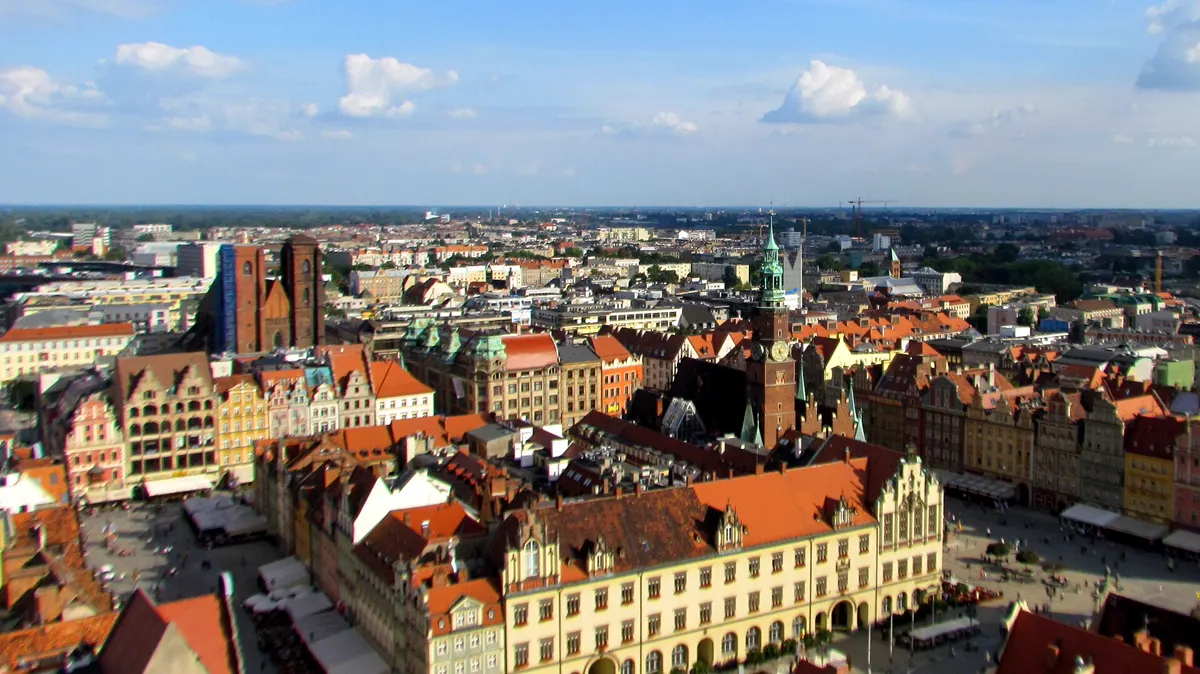
Wroclaw rewards visitors who like to walk. The big draws sit within a compact loop: the huge Market Square, the bronze dwarfs scattered across the pavements, Cathedral Island with its gas lamps, the Panorama Raclawicka rotunda, and Centennial Hall on the eastern edge of the city. This guide to Wroclaw groups the main sights by area so you can plan on foot, starting with the Old Town and working outwards.
Market Square and the Old Town
Start at the Market Square, or Rynek, one of the largest medieval market squares in Europe at roughly 3.8 hectares. Unlike many European squares, it has an inner block of buildings, so the space wraps around a central island rather than opening flat.
The centrepiece is the Gothic Ratusz (Old Town Hall), built in stages over about 250 years. Its ornate south facade and astronomical clock reward a slow look, and the interiors now hold the Museum of Bourgeois Art. Just off the south-west corner lies Salt Square (Plac Solny), once a salt market and today a flower market that trades around the clock.
The dwarfs (krasnale)
Look down and you will start spotting the Wroclawskie krasnale, small bronze figures no taller than your shin. They trace back to the anti-communist Orange Alternative movement of the 1980s, whose activists painted dwarfs over official graffiti. The first permanent bronze figure, Papa Krasnal, appeared in 2001, five more followed in 2005, and the population has since grown into the hundreds.
Each has a job or a joke: one pushes a stone ball, another sleeps, several sit in wheelchairs to flag accessible routes. Hunting for them is an easy way to keep children moving between the bigger stops, and printed or online maps mark their locations.
Cathedral Island (Ostrow Tumski)
North of the Old Town sits Cathedral Island, Wroclaw, the oldest part of the city and once a true island in the Oder. The twin-towered Cathedral of St John the Baptist dominates the skyline, and you can ride a lift up one tower for a view across the river channels.
Come towards dusk. A lamplighter in period dress still lights the gas street lamps by hand each evening, one of the few places in Europe where this continues. Cross by way of Most Tumski i Wyspa Slodowa, the iron bridge draped in padlocks, with the grassy Slodowa island alongside for a riverside break.
Panorama Raclawicka and the National Museum
A short walk east brings you to the Panorama Raclawicka, a 360-degree painting housed in a purpose-built rotunda. Measuring about 15 metres high and 114 metres round, it depicts the 1794 Battle of Raclawice and was painted in 1893 and 1894 by a team led by Jan Styka and Wojciech Kossak. Combined with a foreground of real terrain, it creates a strong sense of standing on the battlefield.
Tickets often include entry to the nearby National Museum in Wrocław, which holds Silesian medieval art and Polish painting. Visits to the Panorama run in timed slots with an audio guide, so book ahead in summer and check the official site for current hours.
The University and the Aula Leopoldina
Back towards the river stands the main building of the University of Wrocław. Its showpiece is the Aula Leopoldina, a Baroque assembly hall completed around 1732 and covered in frescoes, sculpture and gilding. Upstairs, the Mathematical Tower gives another rooftop viewpoint over the Old Town and the Oder.
Centennial Hall and the multimedia fountain
For something newer, head east to Centennial Hall, designed by Max Berg and built between 1911 and 1913. Its reinforced-concrete dome was a landmark of early modern engineering, and the hall has been a UNESCO World Heritage Site since 2006.
Beside it, the Multimedia Fountain at the Pergola runs choreographed shows of water, light and music from spring to autumn. It is free to watch, and the surrounding Szczytnicki Park and Japanese Garden make an easy afternoon out.
District of Four Denominations
West of the square, the District of Four Denominations gathers a Roman Catholic church, a Lutheran church, an Orthodox cathedral and a synagogue within a few streets. The name reflects the communities that lived side by side here, and the area is also known for its bars and small restaurants.
The restored White Stork Synagogue anchors the Jewish corner and runs exhibitions on the city's Jewish history. If you have visited Krakow or Warsaw, this quarter gives Wroclaw's own take on that shared past.
Good to know
Most of these sights lie within a 30-minute walk of the Market Square, with only Centennial Hall needing a tram (routes run from the Old Town in about 15 minutes). Timed-entry attractions such as the Panorama Raclawicka and the Aula Leopoldina can sell out in high season, so book online first and confirm current hours on each venue's official site.
Written by ViewPoland Editorial for ViewPoland, an independent English-language guide to Poland. Published 24 July 2026. Last updated 24 July 2026.