The complete guide · Greater Poland
Poznań
Where the Polish state began, a confident trade-fair city with a Renaissance market square and a strong regional food identity.
Overview
Poznan sits on the Warta river halfway between Berlin and Warsaw, and it has been at the centre of Polish history longer than any other city. The Piast dynasty ruled from Ostrow Tumski, the river island where the country's first cathedral was raised in the 10th century, and Mieszko I and Boleslaw Chrobry are buried there. Locals point out that Poland began here, not in Warsaw or Krakow. That claim shapes how the city sees itself.
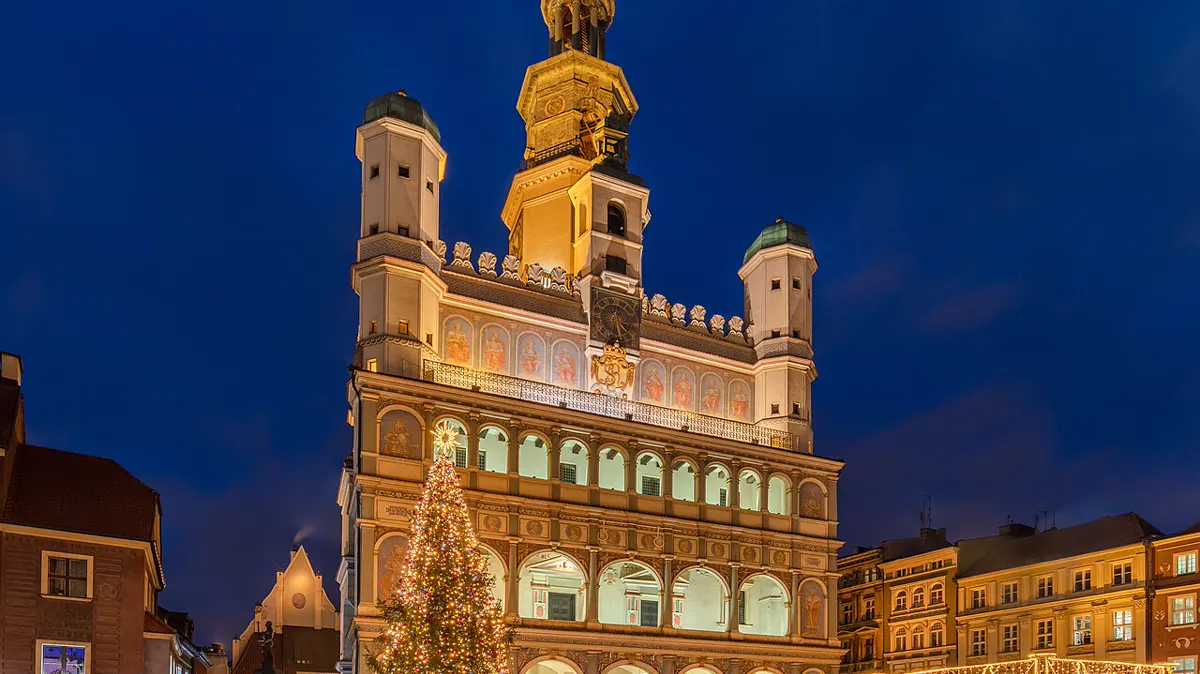
The heart of the city is the Stary Rynek, a large market square rebuilt after wartime destruction, ringed by colourful merchant houses and centred on the Renaissance town hall by Giovanni Battista di Quadro. Every day at noon two mechanical billy goats (koziolki) emerge above the clock and butt heads twelve times while crowds gather below. Around the square sit the pastel Domki Budnicze stalls, the old weighing house, and the fountains of Apollo, Neptune, Proserpina and Mars.
Beyond the square Poznan is a working city with a strong trade fair tradition, a big student population, and neighbourhoods like Jezyce and Wilda that have filled with cafes, craft beer and small kitchens. Stary Browar turned a 19th century brewery into a nationally respected art and shopping complex, Lake Malta hosts rowing regattas and a ski slope, and the Imperial Castle recalls the decades when Prussia governed the city. Poznan Lawica airport is only 7 km from the centre, and fast trains reach Warsaw in around two and a half hours.
Poznań at a glance
Airport
Poznan Lawica (POZ), 7 km west of the centre
Population
About 540,000 in the city, over 1 million in the metro area
Founded
10th century (bishopric established 968)
Good to know
The mechanical goats butting heads on the town hall at noon
Currency
Polish zloty (PLN, zl). Not the euro.
Language
Polish. English is widely spoken in tourism and by younger people.
Time zone
Central European Time (UTC+1, or UTC+2 in summer).
Emergency
112 from any phone, free, English-speaking operators.
Tap water
Safe to drink everywhere in Poland.
Cards
Contactless is accepted almost everywhere, even for small amounts.
Sockets
Type E, 230V. UK and US visitors need an adapter.
Visas
Poland is in the Schengen Area and uses the EU entry rules.
Top things to see in Poznań
Old Market Square
The Renaissance heart of Poznan, where two mechanical goats butt heads on the town hall clock every day at noon.
Ratusz i koziolki
At noon two mechanical billy goats emerge above the Ratusz clock and butt heads twelve times, drawing a crowd every single day. The Renaissance town h...
Katedra
The Archcathedral Basilica of St Peter and St Paul is Poland's oldest cathedral, first raised in the 10th century. Its Golden Chapel holds the tombs o...
Ostrow Tumski, Poznan
The cathedral island where the Polish state and church were born in the tenth century, a short walk from the market square.
Brama Poznania
A modern interactive heritage centre that tells the story of Ostrow Tumski and the beginnings of the Polish state. Its concrete cube is linked to the...
Stary Browar
An old Huggerowie brewery turned into an award winning shopping and art centre that blends 19th century brick with contemporary architecture. It combi...
Zamek Cesarski
Built for Kaiser Wilhelm II in the early 20th century, this imperial castle is one of Europe's youngest royal residences. It now serves as a cultural...
Palmiarnia
One of the largest palm houses in Europe, sheltering thousands of plant species across ten climate pavilions. Towering palms, cacti and a freshwater a...
Poznań Fara (Parish Church of St. Stanislaus)
Poznań's grand Baroque parish church, known for its pink facade, towering Corinthian columns and a famous 19th-century Ladegast organ that plays at fr...
Museums, castles and nature in Poznań
Parks and nature
Lake Malta
A long artificial lake close to the centre, lined with trails, a ski slope and a summer resort.
Cytadela Park
The city's largest park on a former fortress hill, dotted with striking open-air sculpture.
Where to base yourself: the neighbourhoods
Stare Miasto (Old Town)
The Stary Rynek, the town hall with the noon goats, the Fara parish church and the pastel merchant houses. The tourist core, busiest in the evenings when the square's restaurants fill up.
Ostrow Tumski
The river island where the Polish state was born, holding the cathedral with the tombs of the first Piast rulers and the Golden Chapel. Quiet, monumental and best reached on foot over the Bishop Jordan footbridge.
Jezyce
A grid of tall tenement houses just northwest of the centre that has become the city's cafe and small-plate district. Rynek Jezycki market, independent bakeries and Roosevelta bars anchor it.
Wilda
A residential quarter south of the centre next to Park Wilsona and the palm house, now a magnet for young families and craft beer bars. Rynek Wildecki and 28 Czerwca 1956 street are its spine.
Lazarz
West of the fairgrounds, built around the long green Rynek Lazarski market and grand pre-war apartment blocks. Home to the trade fair halls and a growing number of neighbourhood restaurants.
Malta and Nowe Miasto
East of the river around Lake Malta, with the regatta course, the Malta Ski slope, the thermal baths and the Nowe Zoo. Green and family-oriented, a tram ride from the centre.
How to spend one, two or three days in Poznań
Day 1
The Old Town and the goats
- Morning: Start on the Stary Rynek, walk the pastel Domki Budnicze and the four fountains, then climb into the town hall for the Poznan history museum before positioning yourself in the square for the noon goats.
- Afternoon: Lunch on the square, then visit the Croissant Museum (Rogalowe Muzeum) for a live demonstration of how the rogal swietomarcinski is made, and browse the shops along Polwiejska toward Stary Browar.
- Evening: Explore Stary Browar's art courtyards, then have dinner and craft beer in the Old Town or on nearby Wroclawska street.
Day 2
The cradle of Poland
- Morning: Cross to Ostrow Tumski and tour the cathedral, the Golden Chapel and the royal Piast tombs, then see the archaeological multimedia exhibition at Brama Poznania (Porta Posnania).
- Afternoon: Walk or take a tram to the Imperial Castle (Zamek Cesarski) and its exhibitions, and stop at the Enigma Cipher Centre where Poznan mathematicians first broke the German code.
- Evening: Head to Jezyce for dinner among its tenement-house bistros and finish with cocktails on Roosevelta or Dabrowskiego streets.
Day 3
Lake Malta and the parks
- Morning: Take a tram east to Lake Malta, walk or cycle the 5 km loop, and ride the narrow-gauge Maltanka train to the Nowe Zoo.
- Afternoon: Relax at the Termy Maltanskie baths or, in winter, the Malta Ski slope, then cross back for a stroll up the Cytadela hill park with its cemeteries and open-air sculptures.
- Evening: Finish in Wilda or on Swiety Marcin street for casual Greater Poland food and a relaxed last night.
Where to eat and drink in Poznań
Start with what the region does best: Rogal swietomarcinski, Pyry z gzikiem, Plendze (kartoflane placki) and Czernina.
Bamberka
A handsome restaurant right on the Old Market Square serving Greater Poland classics.
Ratuszova
A vaulted cellar on the square, a long-standing choice for hearty regional plates.
Weranda Caffe
A pretty, plant-filled café known for generous breakfasts and cakes.
Piano Bar Restaurant & Cafe
A central Poznan fine-dining room with a seasonal Polish and European menu and a long wine list. One of the city's steadier upscale addresses.
Concordia Design
A design and coffee hub in a restored printworks near Plac Wolnosci with strong espresso and a co-working buzz. Good for a mid-tour break.
Pijalnia Wodki i Piwa
A retro PRL-styled bar chain outlet on the Stary Rynek pouring cheap vodka shots and beer late into the night. A no-frills local institution.
Whiskey in the Jar
A grill and drinks bar off the Old Town known for ribs, whisky and cocktails in a rock-tinged room. Good for a livelier evening.
Where to stay in Poznań
Blow Up Hall 5050
A striking art-design hotel inside the Stary Browar complex, with keyless art-app rooms.
PURO Poznan Stare Miasto
A design hotel near the Old Market with a relaxed bar and bikes for guests.
NH Poznan
A four-star hotel on Swiety Marcin in a 1910 Art Nouveau tenement, run by the NH Hotel Group, with a restaurant, Winter Garden and spa a short walk fr...
Sheraton Poznan Hotel
A large international hotel near Park Wilsona and the fairgrounds with a fitness centre, restaurant and reliable business standards. Popular during th...
IBB Andersia Hotel
A modern tower hotel on Plac Andersa near the central shopping and the station, with panoramic higher floors. Solid value close to transport.
ibis Poznan Stare Miasto
A dependable budget chain hotel within walking distance of the Old Town and the river. Simple, clean and well placed for sightseeing.
Blooms Boutique Hostel & Apartments
A friendly central hostel and apartment mix a short walk from the Stary Rynek, with dorms and private rooms. A budget base close to the sights.
What to eat and drink in Poznań
Local to Poznań
Rogal swietomarcinski
A rich crescent pastry filled with white poppy seed, nuts and candied fruit, protected by an EU PGI mark so only certified bakers may sell it. Poznan eats hundreds of tonnes of them around Saint Martin's Day on 11 November.
Pyry z gzikiem
Jacket potatoes (pyry in the local dialect) served with gzik, a quark cheese whipped with cream, chives and onion. The plainest and most beloved Greater Poland comfort dish.
Plendze (kartoflane placki)
Grated potato pancakes fried crisp, called plendze in Poznan, eaten savoury with sour cream or sweet with sugar. A market and milk-bar staple.
Czernina
A sweet-and-sour duck blood soup with dried fruit and vinegar, a traditional Wielkopolska dish once served, in folklore, to reject a suitor. Increasingly rare but still on old-school menus.
Slepe ryby
A humble potato and roux soup, literally blind fish because it contains no fish at all, thickened with flour and browned onion. Peasant food that turns up on regional tasting menus.
Polish classics worth ordering
Polish cooking is hearty, seasonal and built on soups, dumplings and slow-cooked meat. These are the classics worth seeking out in any city, best at a milk bar or an old-school restaurant rather than a tourist trap.
Pierogi
Half-moon dumplings stuffed with anything from potato and curd cheese (ruskie) to meat, cabbage and mushroom, or sweet fruit. Boiled or pan-fried in butter.
Żurek
A tangy soup of soured rye flour, usually with white sausage and a boiled egg, sometimes served in a bread bowl. The taste of a Polish Easter.
Bigos
The "hunter's stew" of sauerkraut, fresh cabbage and several meats, simmered for days until deep and smoky. Better the second day.
Kotlet schabowy
A breaded, flattened pork cutlet, the Polish Sunday dinner, served with potatoes and mizeria (cucumber in cream) or cabbage.
Gołąbki
Cabbage leaves rolled around minced meat and rice, baked in a tomato or mushroom sauce. The name means "little pigeons".
Placki ziemniaczane
Crisp potato pancakes, eaten savoury with sour cream or, in the mountains, drowned in a goulash (placki po zbojnicku).
Rosol
A clear, golden chicken broth with fine noodles, the traditional start to a Polish Sunday lunch.
Sernik and paczki
For something sweet: sernik (a dense baked cheesecake made with twarog curd) and paczki (rose-jam doughnuts), devoured by the million on Fat Thursday.
Drinks
Poland is a vodka country first, but it also has a serious craft-beer scene and a tradition of homemade fruit liqueurs.
- Wodka
- Drunk cold and neat, in company, with a toast and a bite to follow. Clean rye or potato brands (Belvedere, Chopin, Wyborowa) are the benchmark.
- Nalewki
- Homemade fruit and herb liqueurs, from cherry (wisniowka) to honey-spiced krupnik, often stronger and smoother than they look.
- Craft beer
- Poland has hundreds of craft breweries and multitap bars in every city. Ask for a local piwo rzemieslnicze rather than the mass lagers.
- Non-alcoholic
- Kompot (a jug of stewed fruit) is the homemade soft drink, and in winter grzane piwo (mulled beer) and grzaniec (mulled wine) warm up the markets.
Best day trips from Poznań
Kornik Castle
22 km · 30 min by car or bus
A neo-Gothic castle rebuilt by Tytus Dzialynski, with preserved period interiors and one of Poland's oldest arboretums in its grounds. The White Lady is said to step out of her portrait at night.
Rogalin Palace
20 km · 30 min by car
A grand Baroque and Rococo residence of the Raczynski family with a gallery of Polish and European painting. Its park holds ancient oaks named Lech, Czech and Rus, some over 500 years old.
Gniezno
50 km · 45 min by car or train
The first capital of Poland, where Boleslaw Chrobry was crowned, centred on a cathedral holding the bronze Gniezno Doors carved with scenes from the life of Saint Adalbert. The Piast Route links it back to Poznan.
Biskupin
90 km · 1 hr 20 min by car
A reconstructed Iron Age fortified settlement on a lake peninsula, one of Poland's most important archaeological sites. The autumn archaeology festival draws large crowds.
Morasko Meteorite Reserve
12 km · 25 min by car or tram plus a walk
A forest reserve on the city's northern edge scattered with craters left by a prehistoric meteorite fall, the largest in central Europe. Marked trails loop between the water-filled hollows.
Lednica and Ostrow Lednicki
35 km · 40 min by car
An island in Lake Lednica with the ruins of a Piast palace and chapel, possibly the site of Poland's baptism in 966. The open-air Wielkopolski Ethnographic Park stands nearby.
When to visit Poznań
Poznan is a year-round city break with a flat continental climate, warm summers and cold, sometimes grey winters. The June trade fairs and Saint Martin's Day in November are the two dates that most shape hotel prices.
April to May
Spring
Mild days, blossom in the Cytadela and palm house, and thinner crowds. A good time to walk Ostrow Tumski and Lake Malta before the summer heat.
June to August
Summer
Warm and lively, with regattas on Lake Malta, open-air cafes on the Stary Rynek and events on the Warta riverbank. Trade fairs in June can push hotel prices up sharply.
September to October
Autumn
Crisp weather, golden parks and the Malta and student season energy. The clear headline event is Saint Martin's, which spills into November.
November to March
Winter
Cold and often overcast, but the 11 November Saint Martin's parade down Swiety Marcin and the Christmas market on Plac Wolnosci bring the city alive. Rogale swietomarcinskie are everywhere in mid-November.
Getting to and around Poznań
By air
Poznan Lawica (POZ) is just 7 km west of the centre, with bus L and 159 running in. It focuses on low-cost and regional European routes.
By train
Poznan Glowny sits on the Berlin-Warsaw main line, so fast trains reach both capitals easily, along with Wroclaw and Gdansk.
By bus
FlixBus and coaches stop by the main station and the adjoining Poznan City Center mall.
By car
The A2 motorway passes just south of the city. Central parking is paid, so trams are the easier way in once you arrive.
Trams & buses
MPK trams and buses cover the city well, with fast tram links from the station to the Old Market Square.
Tickets
Time-based tickets work across trams and buses; buy in the app or at machines and validate on board.
On foot
The Old Market Square and its surrounds are compact and walkable, ideal for catching the noon clash of the mechanical goats on the town hall.
Staying connected
- EU roaming
- If you have an EU or UK SIM, roaming works at your normal domestic rate under the roam-like-at-home rules, so most European visitors need to do nothing.
- eSIM
- For visitors from outside Europe, an eSIM from a provider such as Airalo or Holafly is the simplest option, activated before you land with no shop visit.
- Local SIM
- A prepaid SIM from Play, Orange, Plus or T-Mobile costs little and gives generous data. You need your passport to register it, which is a legal requirement.
- Free wifi
- Cafés, hotels, malls and many trams and buses have free wifi, though speeds vary. Do not rely on it for anything sensitive.
Apps to download before you go
A short list of apps that make a Polish trip smoother. Download them before you fly; every link goes straight to the app.

Jakdojade
Public transport
Public transport routes, live departure times and mobile tickets for every Polish city. The first app to install.



Bolt
Rides and taxis
The most widely used ride-hailing app in Poland, usually cheaper than a street taxi, plus e-scooters and shared bikes.

Koleo
Train tickets
Buy Polish train tickets (PKP Intercity and regional) with seat selection, often cheaper than buying at the counter.
Google Maps
Maps and offline
Reliable for walking and public-transport directions nationwide. Download the offline area for your city before you land.

Google Translate
Translation
Install the Polish language pack for offline camera translation of menus and signs.

Revolut
Payments
Hold and spend zloty at the real exchange rate, sidestepping the airport kantor and card DCC markups.

Wise
Payments
A multi-currency account and card that also spends zloty at the real exchange rate, a strong alternative to Revolut.

Booking.com
Stays
The default for hotels and apartments in Poland, with the widest choice and free-cancellation options.
Money, costs and tipping
Poland runs on the zloty, not the euro, and it is one of the better-value city-break destinations in the EU. Cards work nearly everywhere, but a few local habits save you money.
- Pay in zloty, always
- When a card machine or ATM offers to charge you in your home currency, decline it and choose PLN. That "dynamic currency conversion" hides a poor exchange rate and can add 5 to 12 percent.
- Skip airport and street exchange
- Avoid the exchange desks at the airport and the Euronet ATMs in tourist zones, which give weak rates and push DCC. Withdraw from a normal bank ATM (PKO BP, Santander, ING, Pekao) or just pay by card.
- Cash for small things
- Keep a little cash for a milk bar (bar mleczny), a market stall, a toilet (1 to 3 zl), or a rural bus. Everything else takes contactless or Apple/Google Pay.
- Tipping
- Round up or leave about 10 percent in a restaurant if you were happy. Do not say "thank you" when handing over money if you want change back, as it can be taken to mean "keep it".
Safety and local etiquette
Staying safe
Poland is one of the safer countries in Europe, and its cities feel relaxed late into the evening. The risks are the ordinary big-city ones rather than anything unusual.
- Petty theft
- Pickpocketing happens in crowded tourist spots, on packed trams and at big events. Keep your phone and wallet in a front pocket or a zipped bag and you will almost certainly be fine.
- Taxis
- Use an app (Bolt, Uber or Free Now) rather than flagging a random taxi, especially near stations and airports, to avoid inflated fares. The price is fixed and shown up front.
- Nightlife
- Stick to established bars and clubs, watch your drink, and be wary of touts steering you to a "special" venue with a surprise bill. This is rare but worth knowing.
- Emergency number
- Dial 112 for police, ambulance or fire. Operators speak English. Pharmacies (apteka) are widespread and one is always open on a rota.
Local etiquette
Poles are warm once the ice breaks and appreciate a little effort. A few points of etiquette go a long way, especially at the country's many places of memory.
- Greetings
- A firm handshake and eye contact is standard. "Dzień dobry" (good day) and "dziękuję" (thank you) are always welcome, even if the rest is in English.
- Churches and memorials
- Cover shoulders and knees in churches and keep quiet during Mass. At sites such as Auschwitz-Birkenau, dress and behave soberly, and do not take smiling selfies.
- In a home
- If you are invited to someone's home, take off your shoes at the door and bring flowers (an odd number) or chocolates. Never bring an even number of flowers, which is for funerals.
- Toasts
- Vodka is drunk cold in one go with a toast of "na zdrowie" (to health), followed by something to eat. Pace yourself, as refusing every round can seem standoffish.
Who Poznań suits
A quick word on who each Polish city suits and how to make it work for you.
Families
Poland is easy with children: milk bars are cheap and quick, ice cream (lody) is everywhere, and museums and parks are stroller-friendly. Trams are free for small children.
Couples
Cobbled old towns, candlelit cellar restaurants and riverside bars make for an easy romantic weekend, and prices leave room for a proper dinner out.
Solo travellers
Cities are safe and walkable, hostels are sociable, and free walking tours are a good way to meet people. English gets you a long way.
Seniors
Compact centres, plenty of cafés to rest in and good public transport make for a gentle pace. Many museums offer reduced tickets.
Accessibility
Newer trams and buses are low-floor and stations are improving, but medieval cobbles and old tenement stairs can be hard going. Check ahead for lifts.
Poznań: frequently asked questions
The two mechanical billy goats (koziolki) butt heads above the town hall clock every day at noon. Arrive on the Stary Rynek a few minutes early to get a clear view.
One full day covers the Old Town, the noon goats and the cathedral island of Ostrow Tumski where the Polish state began. A second day makes room for Lake Malta, the Imperial Castle and the Jezyce food scene.
Yes, particularly for the noon goats, the Piast-era tombs on Ostrow Tumski and a strong food and craft-beer scene in Jezyce and Wilda. It also breaks up the Berlin to Warsaw rail route well.
It is mid-priced and usually cheaper than Warsaw, but international trade fairs spike hotel rates on certain dates. Check the fair calendar before booking rooms.
It is a rich, crescent-shaped pastry filled with white poppy seed, an EU-protected Poznan specialty tied to St Martin's Day on 11 November. The Croissant Museum on the Stary Rynek runs live demonstrations year-round.
Yes. A large student body and the trade-fair trade mean English is common in hotels, restaurants and the center.
Around the Stary Rynek keeps you in the middle of the sights. Jezyce, a short walk northwest, offers cafes and lower prices among its tenement houses.
Guides to Poznań
Cities near Poznań
About this guide
This guide to Poznań is researched and maintained by the ViewPoland editorial team, and was last reviewed in September 2026. We update it as venues, prices and transport change.