Things to do in Gdańsk
Things to Do in Gdansk
A first-visit guide to Gdansk, grouped by area: the rebuilt Main Town and Long Market, the Motlawa waterfront and the Crane, amber on Mariacka Street, the two twentieth-century history museums, plus Oliwa, Westerplatte and the Tricity link to Sopot and Gdynia.
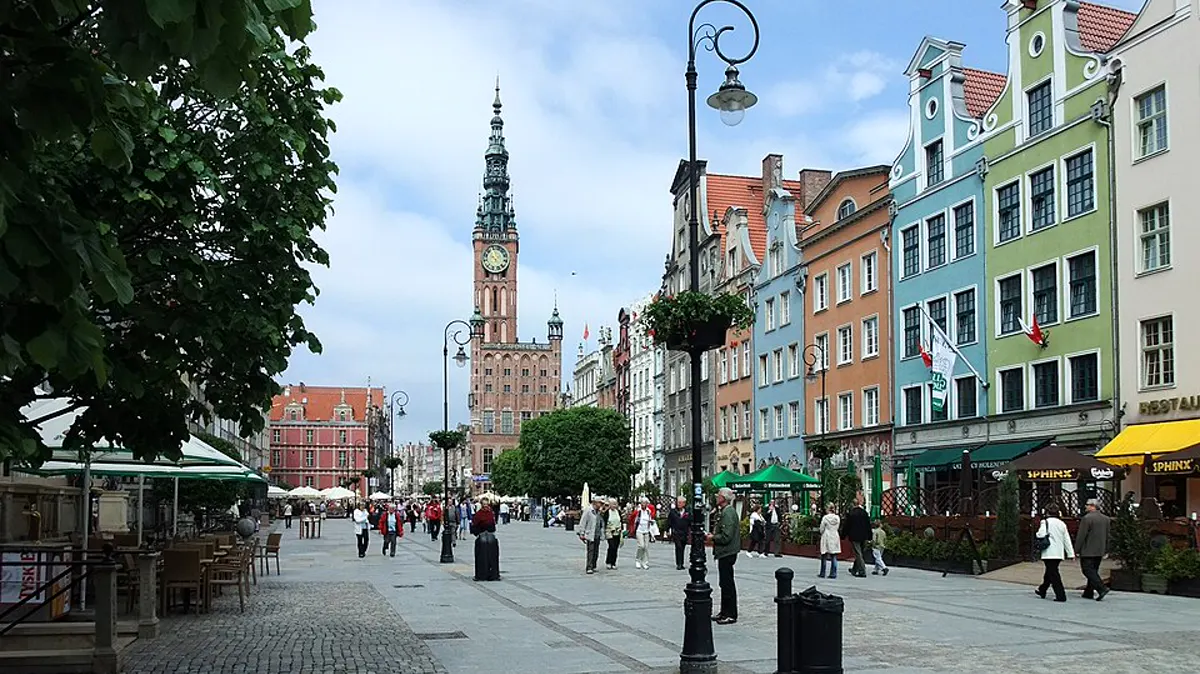
A first visit to Gdansk usually starts on foot in the Main Town, where the rebuilt merchant houses, the Long Market and the Motlawa waterfront sit within a short walk of each other. Add the two big history museums, a morning in Oliwa and a trip out to Westerplatte, and you have a full itinerary. This guide groups the highlights by area so you can plan by neighbourhood rather than by ticking off a list. For the wider picture of the city, see our Gdansk destination page.
The Main Town and the Royal Route
The Main Town is the obvious place to begin, because almost everything you have seen in photographs is here. Enter from the west through the Golden Gate and walk Long Street and the Royal Route, the ceremonial road once used by visiting Polish kings.
The street opens into the Long Market, lined with tall gabled facades. Nearly all of it was rebuilt after 1945, when the old city was left in ruins. The Neptune Fountain stands in the middle, and the tower of the Main Town Hall gives a view over the rooftops if you climb it. Book a table nearby at Gdanski Bowke for regional cooking.
Bazylika Mariacka and Mariacka Street
A block north of the Long Market you reach the two things Gdansk is best known for at close range: a very large brick church and the amber trade. Bazylika Mariacka is one of the largest brick churches in the world, and you can climb its tower for a wide view across the Old and Main Towns.
Running east from the church, Mariacka Street is the address for amber. Its stone terraces and gargoyle waterspouts are lined with small workshops and jewellers selling Baltic amber. Prices vary widely, so it pays to compare a few stalls before buying.
The Motlawa waterfront and the Crane
The Motlawa waterfront is where Gdansk feels like the port it has always been. The riverside promenade runs past former granaries, restaurant boats and departure points for short river cruises.
Its landmark is the Crane, a medieval timber port crane once used to load ships and set masts. It forms part of the National Maritime Museum, so you can go inside as well as photograph it from the far bank. For dinner on the water, the Targ Rybny area is a short walk upstream.
Two museums about the twentieth century
Gdansk holds two of Poland's most significant modern history museums, and both reward a couple of hours. The Museum of the Second World War, which opened in 2017, tells the story of the conflict through a large underground exhibition, with a strong focus on civilian experience.
Near the historic shipyard, the European Solidarity Centre opened in 2014 on the site where the Solidarity trade union began in 1980. Its permanent exhibition traces the movement that helped end communist rule in Poland. The two sit some distance apart, so it is easier to visit them on separate parts of the day.
Oliwa and Westerplatte
To see more than the centre, head to two districts on the edge of the city. Oliwa lies to the north-west and is known for its cathedral and large landscaped park. The cathedral's baroque organ is famous, and short recitals are held through the day in the tourist season.
North of the port, Westerplatte is the peninsula where the first shots of the Second World War were fired on 1 September 1939. It is now an open memorial site with a tall monument and the ruins of the Polish garrison, reachable by bus or by seasonal boat along the river.
Day trips: the Tricity and Malbork
Gdansk forms the largest part of the Tricity, together with Sopot and Gdynia. The three are joined by a frequent SKM commuter train, so Sopot's pier and beaches or Gdynia's harbour are both easy half-day trips. If you are weighing up where to base yourself, our Gdansk or Sopot comparison lays out the trade-offs.
Further out, Malbork Castle, the largest brick castle in the world by land area, is under an hour away by train and makes a strong full-day excursion.
Good to know
The compact Main Town is walkable, but the SKM commuter train is the simplest way to link Gdansk, Sopot and Gdynia; buy a ticket for the correct zones and validate it before boarding. For opening times and current ticket prices at the two history museums, check each official site, as hours change by season. If you want a lighter lunch between sights, the milk bar Bar Mleczny Neptun on Long Street is a long-running budget option.
Written by ViewPoland Editorial for ViewPoland, an independent English-language guide to Poland. Published 24 July 2026. Last updated 24 July 2026.