Things to do in Toruń
Things to Do in Toruń
A walkable guide to Toruń, the war-survived Gothic city where Copernicus was born: the Old Town Hall tower, the Leaning Tower, two gingerbread museums and the classic view from across the Vistula.
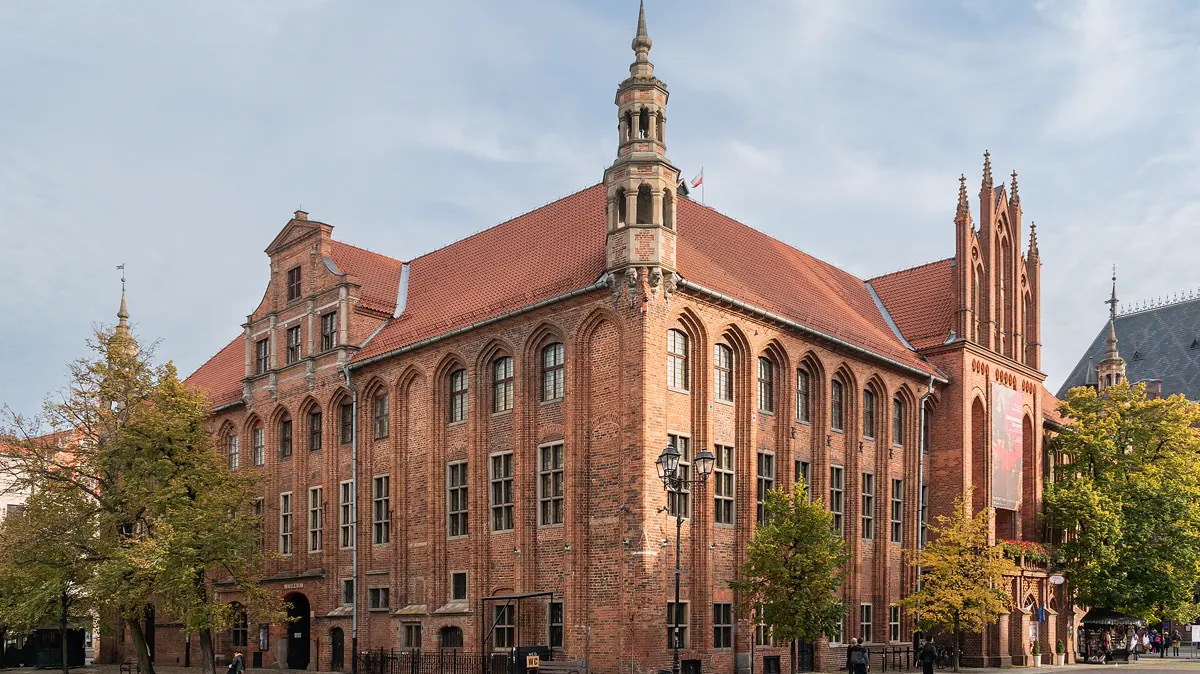
Toruń is a one day city that rewards a second. Its medieval centre came through the war intact, which is rare in Poland, so the brick Gothic churches, granaries and gabled houses around the market square are the originals rather than reconstructions. Nicolaus Copernicus was born here in 1473, and the city has built a good deal around him and around gingerbread. Everything below sits inside a compact loop you can walk.
Toruń Old Town and the Old Town Hall tower
Start on the Old Town Market Square at the Ratusz Staromiejski, one of the finest municipal Gothic buildings in Central Europe. It dates from the late fourteenth century, houses the District Museum, and its tall tower gives the sweeping view over red roofs and the Vistula that most people come for.
The square around it collects the city's smaller pleasures: the Copernicus monument from 1853, which is the standard meeting point, the 1914 Raftsman Fountain with its violin player among bronze frogs, and the gilded Star House, a Baroque townhouse holding the first permanent collection of Asian art in Poland. Artus Court stands on the spot where the Second Peace of Thorn was signed in 1466.
Copernicus in Toruń: the house, the font and the planetarium
Dom Kopernika is a pair of Gothic burgher houses believed to be the astronomer's birthplace, now a museum of his life and era with a recreated fifteenth century merchant household. A few streets away, the Cathedral of Saints John the Baptist and John the Evangelist holds the font where he was baptised, along with the Tuba Dei, one of the largest medieval bells in Poland.
The planetarium occupies a former nineteenth century gas holder and is one of the most visited in the country, which is a fitting use of a round building in Copernicus's home town. In the evening the Cosmopolis Fountain on Rapacki Square runs shows of water, light and music designed around planetary orbits.
Toruń gingerbread: two museums and baking your own
Toruń has baked pierniki for more than six hundred years, and two museums split the subject between them. At the Living Museum of Gingerbread you knead and bake your own using medieval recipes, guided by costumed masters. The Museum of Toruń Gingerbread, inside the former Weese factory, holds the largest gingerbread collection in Europe and the biggest set of historic wooden baking moulds in Central Europe.
For the edible version without the workshop, Cafe Lenkiewicz is a historic confectioner pairing coffee with its own gingerbread specialities.
The Leaning Tower and the Teutonic castle ruins
The Krzywa Wieża is a fourteenth century defensive tower leaning about 1.5 metres out of true, the result of unstable riverside ground rather than the broken vow of a Teutonic knight that local legend prefers. It sits in the line of the medieval walls and gates that still run along the Vistula.
The ruins of the Teutonic Knights' castle mark the order's first stronghold in the Chełmno Land. Townspeople destroyed it in a revolt in 1454, and what survives, the gdanisko tower and the cellars, can be explored today.
Where to get the best view of Toruń
The postcard panorama of the medieval waterfront is taken from the far bank. Cross to Kępa Bazarowa, a wooded island opposite the old town, or walk the Vistula Boulevard on the near side for the frame most photographs use. The brick Dybów Castle ruins on the far bank are free to walk through and look back across the river at the skyline.
Beyond the Old Town: the New Town square and the forts
The New Town Market Square is the medieval New Town's own centre, ringed with Gothic, Baroque and Art Nouveau houses and far quieter than the famous square nearby. Its parish church, St James, begun in 1309, is the only true basilica among the city's medieval churches.
Further out, Fort IV is the best preserved of the ring of nineteenth century Prussian forts around the city and opens its brick corridors, barrack rooms and moats for tours. The ethnographic museum pairs folk-art galleries with a two hectare open-air park of relocated wooden buildings, and sits centrally enough to fold into a walk.
How many days do you need in Toruń
One full day covers the market square, the tower, Copernicus and one gingerbread museum. Two days adds the New Town, the far bank view, the forts and a slower pace. Many people visit as a day trip, and it works, but the old town is at its best in the evening once the coaches have gone. See our Toruń city guide for where to stay, and getting around Poland for train connections from Warsaw and Gdańsk.
Worth knowing
Toruń's old town survived the war, so what you are looking at is genuinely medieval rather than rebuilt. That is unusual in Poland and it is the main reason the centre carries UNESCO World Heritage status.
Written by ViewPoland Editorial for ViewPoland, an independent English-language guide to Poland. Published 13 August 2026. Last updated 13 August 2026.