The complete guide · Lublin Region
Zamość
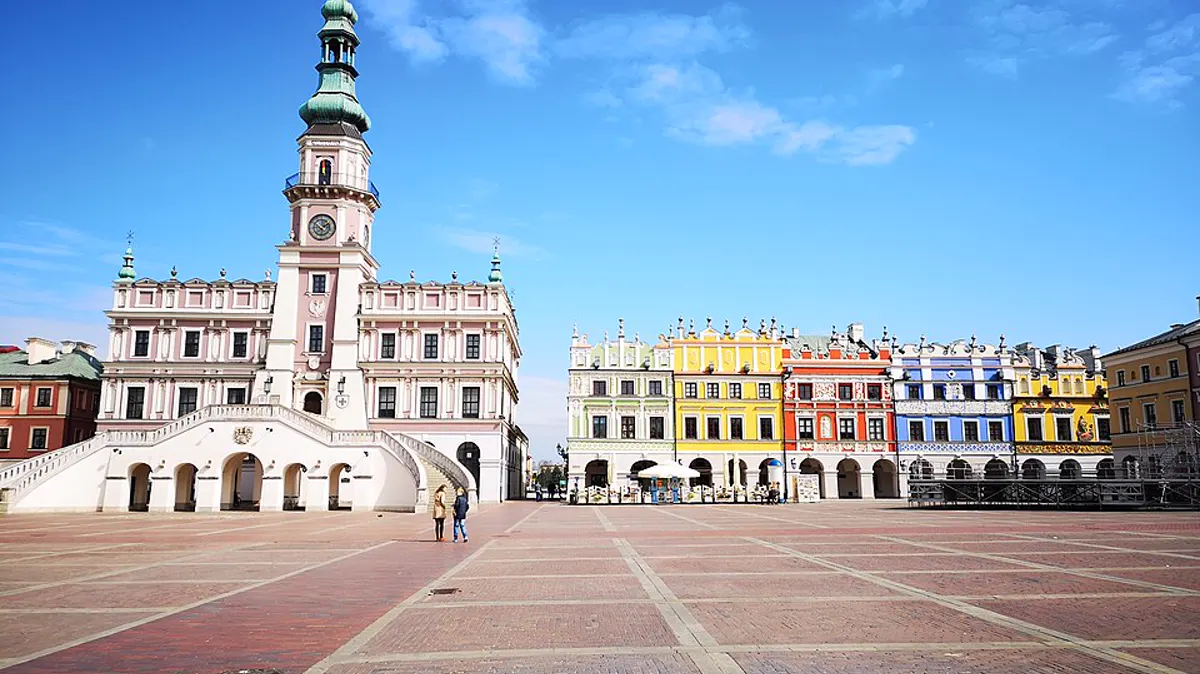
A Renaissance ideal city built from scratch in the sixteenth century, with an arcaded market square that has barely changed in four hundred years.
Overview
Zamosc sits on the edge of the Roztocze uplands in the far south-east of Poland, and unlike most old towns it was not allowed to grow up on its own. It was drawn on paper first. From 1580 the Grand Chancellor Jan Zamoyski commissioned the Paduan architect Bernardo Morando to build him a private town from nothing, a Renaissance citta ideale of the kind Italian theorists sketched but rarely constructed. UNESCO listed the Old Town in 1992 as one of the most complete surviving examples in Central Europe. The result still stands: a rectilinear grid, the arcaded Rynek Wielki, a cathedral by Morando, and a ring of bastion fortifications.
The town was meant to trade and it was meant to be mixed. Zamoyski settled Armenian, Jewish, Greek, Italian, and Sephardic merchants along the routes running towards the Black Sea, and their money paid for the tall painted houses that give the main square its character. The row of Armenian tenements on the north side, deep colours and carved friezes, are the most photographed buildings in the town. Zamoyski also founded the Zamoyski Academy here in 1594, the third institution of higher learning in the old Polish-Lithuanian Commonwealth, which ran until 1784. The fortress earned its keep too: it held off the Cossacks in 1648 and was never taken during the Swedish Deluge of 1656, which is partly why so much of it survives.
It is a small city of roughly 62,000 people, and the historic core is compact enough to see on foot in a day, which makes Zamosc an easy overnight or a longer base for the Roztocze region. It lies about 90 km south-east of Lublin and around 247 km from Warsaw. The nearest airport is Lublin Airport (LUZ) near Swidnik, about 90 km away, though many visitors arrive via Warsaw and drive or take a bus down. People sometimes call it the Padua of the North, after the home city of the man who designed it.
Zamość at a glance
Airport
Lublin Airport (LUZ) near Swidnik, about 90 km north-west; Warsaw is a common alternative by road or rail
Population
About 62,000
Founded
1580, by Grand Chancellor Jan Zamoyski
Good to know
UNESCO-listed Renaissance ideal town by Bernardo Morando, with the arcaded Rynek Wielki, Armenian houses, and a bastion fortress
Currency
Polish zloty (PLN, zl). Not the euro.
Language
Polish. English is widely spoken in tourism and by younger people.
Time zone
Central European Time (UTC+1, or UTC+2 in summer).
Emergency
112 from any phone, free, English-speaking operators.
Tap water
Safe to drink everywhere in Poland.
Cards
Contactless is accepted almost everywhere, even for small amounts.
Sockets
Type E, 230V. UK and US visitors need an adapter.
Visas
Poland is in the Schengen Area and uses the EU entry rules.
Top things to see in Zamość
Great Market Square, Zamosc
A near-perfect Renaissance square of arcaded, pastel burgher houses, the centrepiece of a sixteenth-century ideal city.
Zamość Cathedral (Cathedral of the Resurrection and St Thomas the Apostle)
One of Poland's finest Renaissance churches, designed by Bernardo Morando and paid for by Jan Zamoyski, raised to cathedral rank in 1992.
Bastion VII Underground Tourist Route (Nadszaniec)
A half-kilometre walk through the casemates and galleries of Bastion No 7, the biggest bastion of a fortress that was never taken by an enemy.
Zamość Zoo (Stefan Miler Zoological Garden)
One of Poland's oldest zoos, started in 1918 as a school project by teacher Stefan Miler and now spread over about 13 hectares.
Zamość Town Hall
The pink-and-white town hall on the north side of Zamość's Great Market Square, with a 52-metre clock tower and a fan-shaped double staircase that swe...
Zamość Fortress
Zamość Fortress is one of Poland's best-preserved star fortresses, with restored bastions and curtain walls that now form a walking route around the h...
Franciscan Church (Church of the Annunciation)
The Franciscan Church of the Annunciation is the largest church in Zamość, a monumental Baroque building near Rynek Wielki whose white facade rises cl...
Lwów Gate (Lviv Gate)
A Mannerist gateway built around 1597 to 1599 on the southeastern edge of Zamość's fortified Old Town, once fitted with a drawbridge on the road towar...
Zamoyski Academy
The Zamoyski Academy was Poland's first private university, founded in 1594 by Crown Chancellor Jan Zamoyski. Its restored late-Baroque building stand...
Museums, castles and nature in Zamość
Museums
Zamość Synagogue (Synagogue Centre)
A rare surviving Renaissance synagogue of about 1618, restored by the Foundation for the Preservation of Jewish Heritage and reopened in 2011 as a cul...
Zamość Rotunda (Museum of Martyrdom of the Zamość Region)
A 19th-century circular fort that the Gestapo turned into a place of execution during WWII, now a museum of martyrdom for the Zamość region.
Muzeum Zamojskie (Museum of Zamość, Armenian Houses)
The town museum set inside the ornately decorated 17th-century Armenian houses on the Great Market Square.
Where to base yourself: the neighbourhoods
Stare Miasto (Old Town)
The UNESCO grid inside the old walls, centred on the Rynek Wielki, a square of exactly 100 by 100 metres ringed by arcaded merchant houses. The Town Hall with its fan-shaped external staircase and 52 metre tower, the Armenian tenements, and most cafes and restaurants are all within a few minutes' walk.
The Palace and Academy quarter
The northern end of the plan, where the Zamoyski Palace stood as the notional head of the town in Morando's anthropomorphic layout. Nearby are the buildings of the former Zamoyski Academy and the arsenal, the administrative and scholarly heart of Zamoyski's private capital.
The Fortress ring (Twierdza Zamosc)
The belt of Renaissance bastion fortifications that encircles the Old Town, including Bastion VII, the largest of the seven, and an underground tourist route through the casemates and firing galleries. Much of the ring is now a green walking circuit around the historic core.
Nowe Miasto and Nowa Osada
The newer districts that spread outside the walls after the fortress was decommissioned in the 19th century. This is where the railway station, larger shops, and most modern housing sit, a short walk or bus ride from the Old Town.
How to spend one, two or three days in Zamość
Day 1
The ideal town on foot
- Morning: Begin on the Rynek Wielki and climb the Town Hall tower for the view over the grid, then look at the Armenian houses along the north side and the museum inside them. Walk the arcades that run right around the square.
- Afternoon: Visit the Cathedral of the Resurrection and St Thomas the Apostle, designed by Morando, and its bell tower. Continue past the Zamoyski Palace and the former Academy, then loop through the two smaller markets, Rynek Solny (Salt Market) and Rynek Wodny (Water Market).
- Evening: Eat under the arcades on the main square. Try a Roztocze regional dish and a local beer, and see the illuminated facades once the day-trippers have gone.
Day 2
Fortress, memory and Roztocze
- Morning: Tour Bastion VII and the underground route through the fortifications, then the Arsenal Museum for the story of the siege town. Walk a stretch of the planty, the green ring on the old ramparts.
- Afternoon: Visit the Zamosc Rotunda, a fortification ring used by the Nazi occupiers as an execution and transit site, now a solemn memorial. It is a short walk or drive from the centre.
- Evening: If you have a car, head 30 km west to Zwierzyniec on the edge of Roztocze National Park for the baroque church set on a pond island, or return to the square for a quiet last supper.
Where to eat and drink in Zamość
Start with what the region does best: Cebularz lubelski, Pierog bilgorajski, Forszmak and Gryczaki.
Restauracja Muzealna Ormiańskie Piwnice
Armenian and regional cooking served in the vaulted cellars of a 17th-century Armenian house beside the Town Hall.
Restauracja Bohema
A long-running restaurant on a corner of the Great Market Square, with big outdoor tables looking onto the arcades.
Where to stay in Zamość
Hotel Renesans
A three-star hotel inside the Old Town, a few minutes' walk from the Great Market Square.
Hotel Zamojski
An Old Town hotel spread across renovated historic tenements a step from the Town Hall.
What to eat and drink in Zamość
Local to Zamość
Cebularz lubelski
The regional signature: a round, flat wheat bun topped with diced onion and poppy seed, a Lublin speciality with Jewish roots that holds an EU protected geographical indication. Sold from bakeries across the area and eaten warm.
Pierog bilgorajski
Also called gryczak, a baked yeast-dough pie from nearby Bilgoraj in Roztocze, filled with buckwheat groats, potato, and white curd cheese. Served in slices, warm or cold, as a regional standard.
Forszmak
A hearty Lublin stew of pork, poultry, and pickled cucumber with potato and tomato, another dish tied to the region's Jewish kitchens. Filling cold-weather food that older restaurants still make.
Gryczaki
Regional pierogi filled with buckwheat groats and cheese, a Lublin-area variant sometimes served with sour cream. A simple, cheap plate of the local peasant tradition.
Roztocze honey and preserves
The forests and meadows of the surrounding Roztocze produce honey, fruit preserves, and herbal products sold in the town shops. A practical edible souvenir from the countryside on Zamosc's doorstep.
Polish classics worth ordering
Polish cooking is hearty, seasonal and built on soups, dumplings and slow-cooked meat. These are the classics worth seeking out in any city, best at a milk bar or an old-school restaurant rather than a tourist trap.
Pierogi
Half-moon dumplings stuffed with anything from potato and curd cheese (ruskie) to meat, cabbage and mushroom, or sweet fruit. Boiled or pan-fried in butter.
Żurek
A tangy soup of soured rye flour, usually with white sausage and a boiled egg, sometimes served in a bread bowl. The taste of a Polish Easter.
Bigos
The "hunter's stew" of sauerkraut, fresh cabbage and several meats, simmered for days until deep and smoky. Better the second day.
Kotlet schabowy
A breaded, flattened pork cutlet, the Polish Sunday dinner, served with potatoes and mizeria (cucumber in cream) or cabbage.
Gołąbki
Cabbage leaves rolled around minced meat and rice, baked in a tomato or mushroom sauce. The name means "little pigeons".
Placki ziemniaczane
Crisp potato pancakes, eaten savoury with sour cream or, in the mountains, drowned in a goulash (placki po zbojnicku).
Rosol
A clear, golden chicken broth with fine noodles, the traditional start to a Polish Sunday lunch.
Sernik and paczki
For something sweet: sernik (a dense baked cheesecake made with twarog curd) and paczki (rose-jam doughnuts), devoured by the million on Fat Thursday.
Drinks
Poland is a vodka country first, but it also has a serious craft-beer scene and a tradition of homemade fruit liqueurs.
- Wodka
- Drunk cold and neat, in company, with a toast and a bite to follow. Clean rye or potato brands (Belvedere, Chopin, Wyborowa) are the benchmark.
- Nalewki
- Homemade fruit and herb liqueurs, from cherry (wisniowka) to honey-spiced krupnik, often stronger and smoother than they look.
- Craft beer
- Poland has hundreds of craft breweries and multitap bars in every city. Ask for a local piwo rzemieslnicze rather than the mass lagers.
- Non-alcoholic
- Kompot (a jug of stewed fruit) is the homemade soft drink, and in winter grzane piwo (mulled beer) and grzaniec (mulled wine) warm up the markets.
Best day trips from Zamość
Zwierzyniec
30 km · 30 min by car
The historic gateway to Roztocze National Park, best known for the baroque Church of St John of Nepomuk set on a small island in a pond. A good base for walking trails, the Echo ponds, and the park's Polish konik horses.
Szczebrzeszyn
20 km · 25 min by car
A small town made famous by the Polish tongue-twister about a beetle in the reeds, marked by a bronze beetle statue in the centre. It has an old market square and one of the country's better-known Jewish cemeteries on the hillside.
Krasnobrod
30 km · 40 min by car
A quiet spa and resort town deeper into Roztocze, set among pine forests and walking trails. A restful stop for the microclimate, the sanctuary church, and easy hikes.
Belzec
50 km · 50 min by car
The site of a former Nazi extermination camp, now a museum and memorial run as a branch of the State Museum at Majdanek. A sombre but important visit for those tracing the region's wartime history.
Lublin
90 km · 1 h 30 min by car or bus
The regional capital, with a large medieval Old Town, a hilltop castle and its Gothic chapel, and the cuisine that gives the whole region its cebularz flatbread. Worth a full day in its own right.
When to visit Zamość
Zamosc is walkable year-round, but the arcades, outdoor tables, and the light on the Renaissance facades are best from late spring to early autumn. The Roztocze countryside on the doorstep is greenest in the same months.
April to May
Spring
Mild and quiet, with the planty ring greening up and few coaches on the square. A comfortable time for the fortress walk and for day trips into Roztocze.
June to August
Summer
Warmest and busiest, with cafe tables filling the arcades and cultural events on the Rynek Wielki. Book accommodation ahead on summer weekends.
September to October
Autumn
Warm light on the painted houses, harvest produce at the markets, and the Roztocze forests turning colour. A strong season for photography and walking.
November to March
Winter
Cold and often grey, but the square is calm and the illuminated arcades reward a short break. Some outdoor attractions and the fortress route may keep shorter hours.
Getting to and around Zamość
By bus
Buses and minibuses are the practical way in, since Zamosc sits in the far southeast. FlixBus and regional coaches link it with Lublin in about two hours and run daily to Warsaw and Rzeszow.
By car
The S17 expressway from Warsaw and Lublin brings you most of the way, continuing on the DK17 toward the Hrebenne border. Leave the car outside the Old Town, which is a restricted, largely pedestrian core.
By train
Rail is slow and limited here. REGIO trains from Zamosc Starowka reach Lublin in roughly two hours, about five times a day, where you change for faster onward services.
By air
There is no local airport. The nearest is Lublin (LUZ), around 90 km northwest, while Rzeszow (RZE) and Warsaw offer wider route choice further afield.
On foot
The Renaissance Old Town, a UNESCO site, is compact and flat. The Great Market Square, the arsenal and the fortifications all sit within a few minutes' walk of each other.
City buses
Local MZK buses cover the wider town and reach the train station on the edge of the centre. Single tickets are cheap and cover the short hops you are likely to need.
Staying connected
- EU roaming
- If you have an EU or UK SIM, roaming works at your normal domestic rate under the roam-like-at-home rules, so most European visitors need to do nothing.
- eSIM
- For visitors from outside Europe, an eSIM from a provider such as Airalo or Holafly is the simplest option, activated before you land with no shop visit.
- Local SIM
- A prepaid SIM from Play, Orange, Plus or T-Mobile costs little and gives generous data. You need your passport to register it, which is a legal requirement.
- Free wifi
- Cafés, hotels, malls and many trams and buses have free wifi, though speeds vary. Do not rely on it for anything sensitive.
Apps to download before you go
A short list of apps that make a Polish trip smoother. Download them before you fly; every link goes straight to the app.

Jakdojade
Public transport
Public transport routes, live departure times and mobile tickets for every Polish city. The first app to install.


Bolt
Rides and taxis
The most widely used ride-hailing app in Poland, usually cheaper than a street taxi, plus e-scooters and shared bikes.

Koleo
Train tickets
Buy Polish train tickets (PKP Intercity and regional) with seat selection, often cheaper than buying at the counter.
Google Maps
Maps and offline
Reliable for walking and public-transport directions nationwide. Download the offline area for your city before you land.

Google Translate
Translation
Install the Polish language pack for offline camera translation of menus and signs.

Revolut
Payments
Hold and spend zloty at the real exchange rate, sidestepping the airport kantor and card DCC markups.

Wise
Payments
A multi-currency account and card that also spends zloty at the real exchange rate, a strong alternative to Revolut.

Booking.com
Stays
The default for hotels and apartments in Poland, with the widest choice and free-cancellation options.
Money, costs and tipping
Poland runs on the zloty, not the euro, and it is one of the better-value city-break destinations in the EU. Cards work nearly everywhere, but a few local habits save you money.
- Pay in zloty, always
- When a card machine or ATM offers to charge you in your home currency, decline it and choose PLN. That "dynamic currency conversion" hides a poor exchange rate and can add 5 to 12 percent.
- Skip airport and street exchange
- Avoid the exchange desks at the airport and the Euronet ATMs in tourist zones, which give weak rates and push DCC. Withdraw from a normal bank ATM (PKO BP, Santander, ING, Pekao) or just pay by card.
- Cash for small things
- Keep a little cash for a milk bar (bar mleczny), a market stall, a toilet (1 to 3 zl), or a rural bus. Everything else takes contactless or Apple/Google Pay.
- Tipping
- Round up or leave about 10 percent in a restaurant if you were happy. Do not say "thank you" when handing over money if you want change back, as it can be taken to mean "keep it".
Safety and local etiquette
Staying safe
Poland is one of the safer countries in Europe, and its cities feel relaxed late into the evening. The risks are the ordinary big-city ones rather than anything unusual.
- Petty theft
- Pickpocketing happens in crowded tourist spots, on packed trams and at big events. Keep your phone and wallet in a front pocket or a zipped bag and you will almost certainly be fine.
- Taxis
- Use an app (Bolt, Uber or Free Now) rather than flagging a random taxi, especially near stations and airports, to avoid inflated fares. The price is fixed and shown up front.
- Nightlife
- Stick to established bars and clubs, watch your drink, and be wary of touts steering you to a "special" venue with a surprise bill. This is rare but worth knowing.
- Emergency number
- Dial 112 for police, ambulance or fire. Operators speak English. Pharmacies (apteka) are widespread and one is always open on a rota.
Local etiquette
Poles are warm once the ice breaks and appreciate a little effort. A few points of etiquette go a long way, especially at the country's many places of memory.
- Greetings
- A firm handshake and eye contact is standard. "Dzień dobry" (good day) and "dziękuję" (thank you) are always welcome, even if the rest is in English.
- Churches and memorials
- Cover shoulders and knees in churches and keep quiet during Mass. At sites such as Auschwitz-Birkenau, dress and behave soberly, and do not take smiling selfies.
- In a home
- If you are invited to someone's home, take off your shoes at the door and bring flowers (an odd number) or chocolates. Never bring an even number of flowers, which is for funerals.
- Toasts
- Vodka is drunk cold in one go with a toast of "na zdrowie" (to health), followed by something to eat. Pace yourself, as refusing every round can seem standoffish.
Who Zamość suits
A quick word on who each Polish city suits and how to make it work for you.
Families
Poland is easy with children: milk bars are cheap and quick, ice cream (lody) is everywhere, and museums and parks are stroller-friendly. Trams are free for small children.
Couples
Cobbled old towns, candlelit cellar restaurants and riverside bars make for an easy romantic weekend, and prices leave room for a proper dinner out.
Solo travellers
Cities are safe and walkable, hostels are sociable, and free walking tours are a good way to meet people. English gets you a long way.
Seniors
Compact centres, plenty of cafés to rest in and good public transport make for a gentle pace. Many museums offer reduced tickets.
Accessibility
Newer trams and buses are low-floor and stations are improving, but medieval cobbles and old tenement stairs can be hard going. Check ahead for lifts.
Zamość: frequently asked questions
The UNESCO-listed Old Town fits comfortably into a day. An overnight lets you see the arcaded Rynek Wielki without the day-trip crowds and use the town as a base for the Roztocze hills.
Yes. It is one of the most complete Renaissance planned towns in Central Europe, drawn on paper from 1580 by the architect Bernardo Morando, with painted Armenian houses and intact bastion fortifications.
Yes, it lies about 90 km southeast, roughly 1.5 hours by bus or car. Many visitors pair it with the nearby Roztocze countryside around Zwierzyniec.
No, it is inexpensive by Polish standards, with restaurant mains often 30 to 50 PLN and modest room rates.
Some hotel and main-square restaurant staff speak English, but this is a small city, so expect less than in Krakow or Warsaw. A phrasebook or translation app helps.
Inside or right beside the Old Town, so the Rynek Wielki, the cathedral and the fortifications are all on your doorstep.
Cities near Zamość
About this guide
This guide to Zamość is researched and maintained by the ViewPoland editorial team, and was last reviewed in September 2026. We update it as venues, prices and transport change.