Things to do in Poznań
Things to Do in Poznań
What to see in Poznań on foot, from the goats that butt heads on the town hall clock at noon to the cathedral island where the Polish state began, the Enigma museum and the Stary Browar.
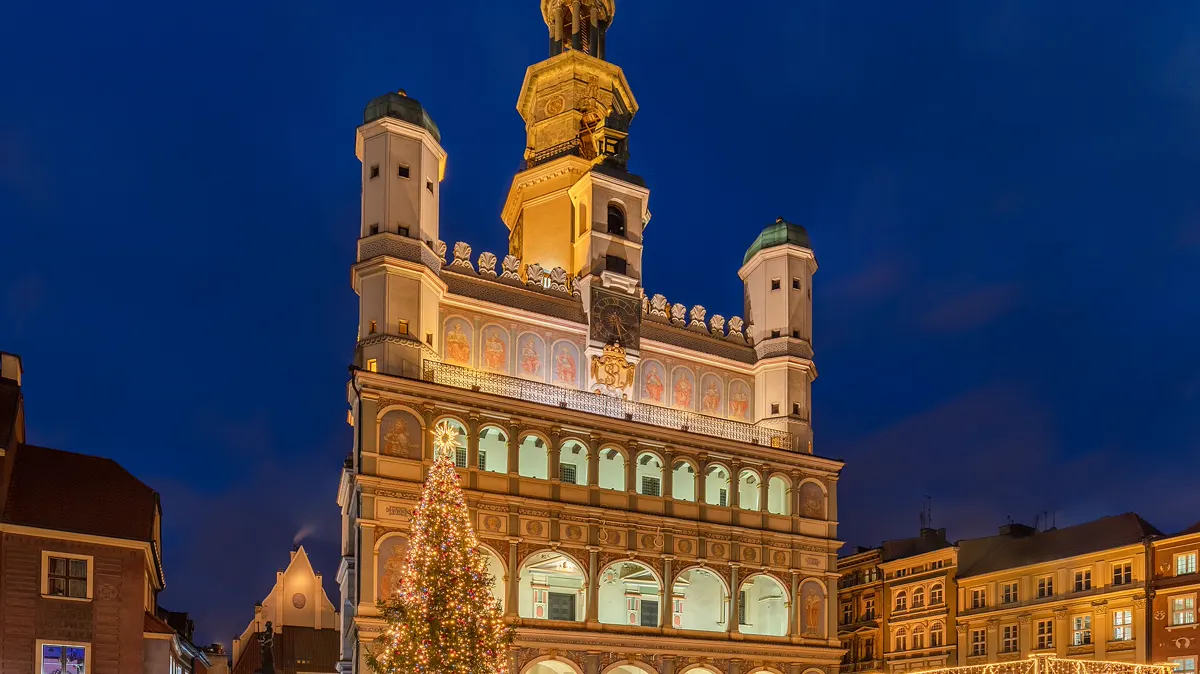
Poznań works as a one or two day city. The Old Market Square, the cathedral island where the Polish state began and a run of good museums sit close enough to walk between, and the two mechanical goats that butt heads on the town hall clock at noon give the day one fixed appointment. This guide takes the sights in the order that makes sense on foot, and leaves the parks, lakes and zoos at the end for anyone staying longer.
Old Market Square and the goats at noon
The Stary Rynek is the Renaissance heart of the city. Its centrepiece is the Ratusz, the town hall remodelled by Giovanni Battista di Quadro, and every day at noon two mechanical billy goats emerge above the clock and butt heads twelve times. The whole thing lasts a minute and draws a crowd well before it starts, so time your first morning around it. The building also houses the city history museum.
The square itself is ringed by tall merchant houses with plenty at ground level. Bamberka serves Greater Poland classics right on the square, Ratuszova does hearty regional plates in a vaulted cellar, and the small Croissant Museum runs an hour-long bilingual show on the St Martin's croissant that ends with you shaping one yourself.
Ostrów Tumski, where the Polish state began
A short walk east of the square is Ostrów Tumski, the cathedral island where the Polish state and church were founded in the tenth century. The Archcathedral Basilica of St Peter and St Paul is the oldest cathedral in Poland, first raised in the 900s, and its Golden Chapel holds the tombs of Mieszko I and Bolesław Chrobry, the first two Polish rulers.
Across a footbridge over the Cybina sits Brama Poznania, a heritage centre in a concrete cube that tells the island's story with interactive displays. Take it before the cathedral rather than after: it supplies the context that makes the tombs mean something. On the way back, the revived cobbled district of Śródka has a large trompe-l'oeil mural on its own small square that recreates the streetscape of a century ago.
The Enigma Cipher Centre and the only Monet in Poland
Poznań has two museums worth planning around. The Enigma Cipher Centre tells the story of the three Polish mathematicians who first broke the German Enigma cipher, with a genuine machine on display and hands-on cryptography to try. It is the rare technical museum that works for people who are not technical.
The National Museum is one of the largest and oldest in the country, and holds the only Claude Monet on public display in Poland. Its Gallery of Painting and Sculpture runs from medieval work to the twentieth century. Both museums sit within the central walking loop.
Where to get the best view of Poznań
The Royal Castle on Przemysł Hill was reconstructed above the Old Market Square and now holds the Museum of Applied Arts, along with a 43 metre view tower that gives the clearest look over the rooftops. If you only climb one thing here, climb this.
Stary Browar, the Imperial Castle and modern Poznań
Stary Browar is an old brewery turned into a shopping and art centre, with nineteenth century brick set against contemporary architecture, a sculpture garden and rotating exhibitions. It is a genuinely good building rather than a mall with a history plaque.
Nearby, Zamek Cesarski was built for Kaiser Wilhelm II in the early twentieth century, which makes it one of the youngest royal residences in Europe. It works as a cultural centre today and preserves Hitler's unfinished study from the war years. For a different century of ambition, Okrąglak is a cylindrical nine storey landmark of Polish modernism on Mielżyńskiego Street, designed by Marek Leykam and built between 1948 and 1954.
Parks, the palm house and the two zoos
The Palmiarnia in Wilson Park is one of the largest palm houses in Europe, with thousands of plant species across ten climate pavilions and a freshwater aquarium. The university botanical garden covers 22 hectares with around 7,000 plant taxa and is free to walk.
For open space, Cytadela Park is the city's largest, laid out on a former fortress hill and dotted with open-air sculpture, while Lake Malta is a long artificial lake close to the centre with trails, a ski slope and a summer resort. Poznań also has two zoos: the 120 hectare New Zoo east of the centre, reachable in summer by the Maltanka narrow-gauge railway, and the compact Old Zoo, the oldest continuously operating zoological garden in Poland.
How many days do you need in Poznań
One full day covers the Old Market Square, Ostrów Tumski and one museum without rushing. Two days lets you add the second museum, the castle tower and either Stary Browar or the parks. Three is comfortable if you want the zoos, Lake Malta or a slower pace. The centre is walkable end to end, and trams cover the rest cheaply. See our Poznań city guide for where to stay and eat, and getting around Poland for reaching the city by train.
One thing to time
The goats appear once a day, at noon sharp, and the crowd gathers on the Stary Rynek well before. Everything else in Poznań can wait; that cannot.
Written by ViewPoland Editorial for ViewPoland, an independent English-language guide to Poland. Published 13 August 2026. Last updated 13 August 2026.