The complete guide · Lublin Region
Kazimierz Dolny
A small town of Renaissance granaries on the Vistula that has drawn painters for over a century, and weekend crowds for its setting and bread.
Overview
Kazimierz Dolny stands on the right bank of the Vistula about 50 km west of Lublin, and it is small even by the standards of Polish country towns, home to only around 2,500 people. What it has instead of size is a preserved face. The town rose on the grain trade that once floated down the Vistula, growing rich through the 16th and the first half of the 17th century, then slid into a long backwater when that trade collapsed. The stagnation was its luck: with no money to rebuild, the Renaissance market square, the granaries, and the merchant houses simply stayed put.
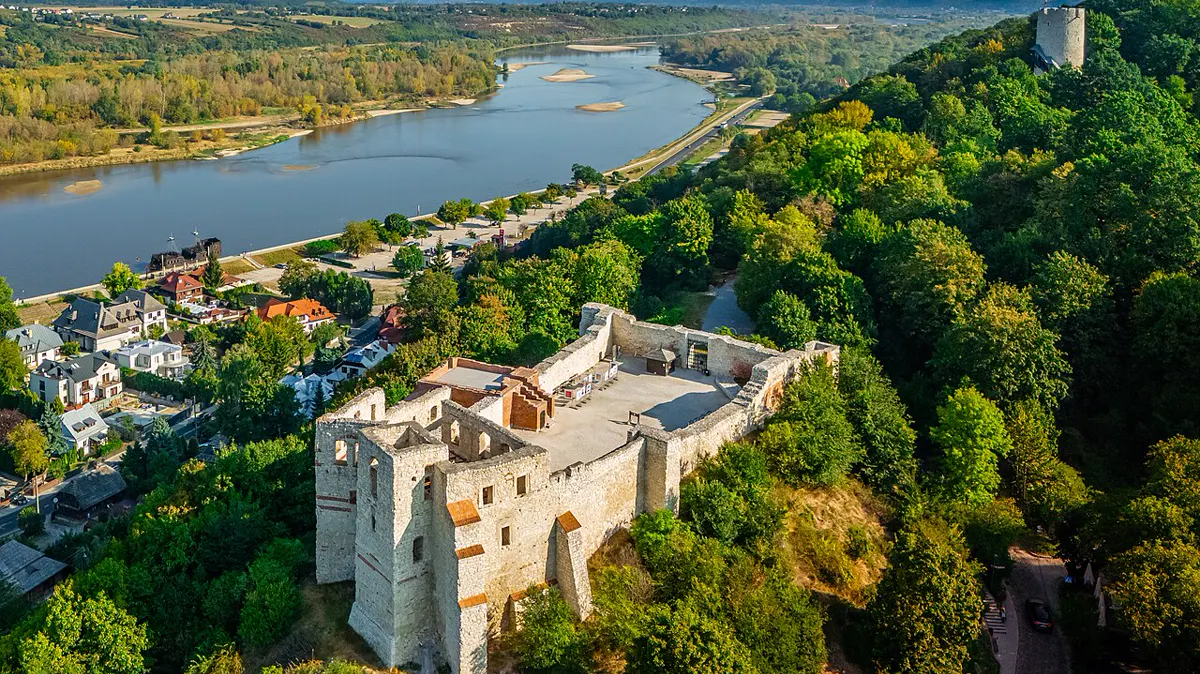
The centrepiece is the Rynek, a sloping market square with an old wooden well at its middle and the Renaissance facade of the parish church, the Fara, looking down from a rise. Two of the finest houses on the square belong to the Przybyla brothers, decorated in the early 17th century with reliefs of their patron saints Nicholas and Christopher. Above the town sit the ruins of a 14th century royal castle and a separate round defensive tower, the baszta, older still. Along the river stand the tall brick granaries that once held the grain. The town takes its name from King Casimir III the Great, who granted its charter in the first half of the 14th century.
From the 19th century onward Kazimierz found a second life as an artists' town, and it never really let go of it. Painters came for the light and the loess landscape and kept coming through wars and changing fashions, which makes this one of the few artists' colonies in Europe with an almost unbroken run to the present. Galleries and easels are still part of the streetscape, and every summer the Two Riversides film and art festival fills the square. Around the town, deep loess ravines called wawozy cut through the hills, and bakeries sell the local rooster-shaped bread. Warsaw is roughly 140 km away, about two and a half hours by road.
Kazimierz Dolny at a glance
Airport
Lublin Airport (LUZ) near Swidnik is the closest, roughly an hour by car; Warsaw is a common alternative about 140 km away
Population
About 2,500
Founded
Town charter granted by King Casimir III the Great in the first half of the 14th century
Good to know
Renaissance market town and long-running artists' colony on the Vistula, with granaries, a ruined castle, loess ravines, and rooster-shaped bread
Currency
Polish zloty (PLN, zl). Not the euro.
Language
Polish. English is widely spoken in tourism and by younger people.
Time zone
Central European Time (UTC+1, or UTC+2 in summer).
Emergency
112 from any phone, free, English-speaking operators.
Tap water
Safe to drink everywhere in Poland.
Cards
Contactless is accepted almost everywhere, even for small amounts.
Sockets
Type E, 230V. UK and US visitors need an adapter.
Visas
Poland is in the Schengen Area and uses the EU entry rules.
Top things to see in Kazimierz Dolny
Three Crosses Mountain (Gora Trzech Krzyzy)
A short climb to three hilltop crosses raised after a 1708 plague, with the best wide view over the town and the Vistula bend.
Przybyla Houses on the Market Square
Two richly carved Renaissance merchant houses of about 1615, whose facades of saints dominate the market square.
Parish Church of St John the Baptist and St Bartholomew (Fara)
The town's white-fronted parish church, rebuilt in the 1610s, home to one of Poland's oldest preserved organs.
Kazimierz Dolny to Janowiec Ferry
A short Vistula ferry crossing to Janowiec and its Renaissance castle ruins, running on a route used for centuries.
Celej House (Nadwislanskie Museum)
A Renaissance-era merchant townhouse on Senatorska Street, famous for its elaborate carved gable and now home to a gallery of paintings and portraits...
Reformed Franciscan Church and Monastery
A Baroque church and working Franciscan monastery set on a hill above Kazimierz Dolny, reached by a terraced path with a wide view over the town and t...
Vistula Boulevard (Riverside Promenade)
A riverside promenade along the Vistula in Kazimierz Dolny, popular for a walk with views across to the ruins of Janowiec Castle and a place to catch...
Former Synagogue (Synagoga), Kazimierz Dolny
An 18th-century limestone synagogue on Lubelska Street that was once the centre of Jewish life in Kazimierz Dolny and now houses a small exhibition on...
Jewish Cemetery and Wailing Wall Memorial
A memorial wall in Kazimierz Dolny built from around 600 surviving Jewish tombstones, split by a vertical crack that stands for the fate of Poland's J...
Museums, castles and nature in Kazimierz Dolny
Museums
Kuncewicz House (Dom Kuncewiczow)
The preserved 1930s villa of writer Maria Kuncewiczowa, kept with its original furnishings as a literary house museum.
Castles
Kazimierz Dolny Castle and Tower
The limestone ruins of a 14th-century royal castle and an older hilltop tower that once watched over the Vistula ferry crossing.
Parks and nature
Korzeniowy Dol Gorge
A steep-walled loess ravine near the town where ancient tree roots twist out of the earthen banks along an easy path.
Where to base yourself: the neighbourhoods
Rynek (Market Square)
The heart of the town, a sloping square with a wooden well at its centre and the Renaissance parish church, the Fara, above it. The decorated Przybyla brothers' houses, galleries, cafes, and the bakeries selling rooster bread all sit around or just off the square.
Castle Hill and the Three Crosses Mountain
The high ground above the town, holding the ruins of the 14th century royal castle and the older round watchtower, the baszta. A short climb further leads to the Three Crosses Mountain (Gora Trzech Krzyzy) and the widest view over the town and the Vistula.
The Vistula waterfront
The riverside edge of town, lined with the tall brick granaries (spichlerze) that stored the grain trade of the 16th and 17th centuries. This is where the seasonal ferry crosses to Janowiec and where river boats and walks begin.
The ravines and loess country
The wooded hills wrapping the town, cut by deep loess gorges called wawozy, of which Korzeniowy Dol with its exposed tree roots is the best known. A network of marked walking paths threads between the ravines and the hilltop crosses.
How to spend one, two or three days in Kazimierz Dolny
Day 1
The market town and the river
- Morning: Start on the Rynek at the wooden well, look over the Przybyla brothers' houses, and go into the Fara parish church. Buy a rooster-shaped loaf from one of the square's long-running bakeries.
- Afternoon: Climb to the castle ruins and the round tower above the town, then walk along the Vistula past the old brick granaries. Browse the galleries that fill the streets off the square.
- Evening: Eat near the market square and finish with the view. In summer the Two Riversides festival may have events on the Rynek and along the river.
Day 2
Ravines, viewpoints and Janowiec
- Morning: Walk into the Korzeniowy Dol ravine, a sunken loess gully with tree roots reaching out of its walls, then climb to the Three Crosses Mountain for the panorama over the town and river.
- Afternoon: Take the seasonal ferry across the Vistula to Janowiec and its large ruined Renaissance castle, which was built in the early 16th century and wrecked during the Swedish wars.
- Evening: Return on the ferry for a last supper in town, or drive the short distance to Naleczow or Pulawy if you are moving on.
Where to eat and drink in Kazimierz Dolny
Start with what the region does best: Kazimierski kogut, Cebularz lubelski, Gryczaki and regional pierogi and Vistula freshwater fish.
Piekarnia Sarzynski
The bakery that made the Kazimierz rooster its symbol, hand-shaping and baking the sweet yeast pastry daily.
Herbaciarnia u Dziwisza
An antique-filled tea room and gallery pouring a long list of teas alongside homemade cakes.
Where to stay in Kazimierz Dolny
Krol Kazimierz Hotel & SPA
A large riverside spa hotel set inside a converted 17th-century grain warehouse, with a pool and sauna complex.
Villa Bohema
A small central hotel a short walk from the market square, with an indoor pool and a sauna.
What to eat and drink in Kazimierz Dolny
Local to Kazimierz Dolny
Kazimierski kogut
The town's own rooster-shaped bread, hand-shaped and baked here for over a century and sold from the market square bakeries. More a keepsake than a meal, though it is a real yeast loaf you can eat.
Cebularz lubelski
A round, flat wheat bun topped with diced onion and poppy seed, the Lublin region's signature bake, with an EU protected geographical indication. Sold across the area and best eaten warm.
Gryczaki and regional pierogi
Lublin-area pierogi and baked pies filled with buckwheat groats and white curd cheese, sometimes served with sour cream. Simple, filling country food you will find on local menus.
Vistula freshwater fish
Riverside restaurants often serve freshwater fish such as trout or carp, a natural fit for a town that grew up on the water. Ask what is fresh rather than expecting a fixed menu.
Polish classics worth ordering
Polish cooking is hearty, seasonal and built on soups, dumplings and slow-cooked meat. These are the classics worth seeking out in any city, best at a milk bar or an old-school restaurant rather than a tourist trap.
Pierogi
Half-moon dumplings stuffed with anything from potato and curd cheese (ruskie) to meat, cabbage and mushroom, or sweet fruit. Boiled or pan-fried in butter.
Żurek
A tangy soup of soured rye flour, usually with white sausage and a boiled egg, sometimes served in a bread bowl. The taste of a Polish Easter.
Bigos
The "hunter's stew" of sauerkraut, fresh cabbage and several meats, simmered for days until deep and smoky. Better the second day.
Kotlet schabowy
A breaded, flattened pork cutlet, the Polish Sunday dinner, served with potatoes and mizeria (cucumber in cream) or cabbage.
Gołąbki
Cabbage leaves rolled around minced meat and rice, baked in a tomato or mushroom sauce. The name means "little pigeons".
Placki ziemniaczane
Crisp potato pancakes, eaten savoury with sour cream or, in the mountains, drowned in a goulash (placki po zbojnicku).
Rosol
A clear, golden chicken broth with fine noodles, the traditional start to a Polish Sunday lunch.
Sernik and paczki
For something sweet: sernik (a dense baked cheesecake made with twarog curd) and paczki (rose-jam doughnuts), devoured by the million on Fat Thursday.
Drinks
Poland is a vodka country first, but it also has a serious craft-beer scene and a tradition of homemade fruit liqueurs.
- Wodka
- Drunk cold and neat, in company, with a toast and a bite to follow. Clean rye or potato brands (Belvedere, Chopin, Wyborowa) are the benchmark.
- Nalewki
- Homemade fruit and herb liqueurs, from cherry (wisniowka) to honey-spiced krupnik, often stronger and smoother than they look.
- Craft beer
- Poland has hundreds of craft breweries and multitap bars in every city. Ask for a local piwo rzemieslnicze rather than the mass lagers.
- Non-alcoholic
- Kompot (a jug of stewed fruit) is the homemade soft drink, and in winter grzane piwo (mulled beer) and grzaniec (mulled wine) warm up the markets.
Best day trips from Kazimierz Dolny
Janowiec
Across the Vistula · seasonal ferry
A large ruined Renaissance castle on the far bank, built in the early 16th century and destroyed during the Swedish Deluge. The ferry from Kazimierz runs roughly April to November, making it the easiest and most scenic trip from town.
Pulawy
15 km · 30 min by car
A town built around the Czartoryski palace and its landscape park, home to the Temple of the Sibyl, which held one of the first public museum collections on Polish soil. Good for a half day among the gardens and pavilions.
Naleczow
30 km · 40 min by car
A 19th century spa town set in wooded ravines, long favoured for its restful climate and its literary connections. A calm stop for the spa park, villas, and walking paths.
Lublin
50 km · 1 h by car
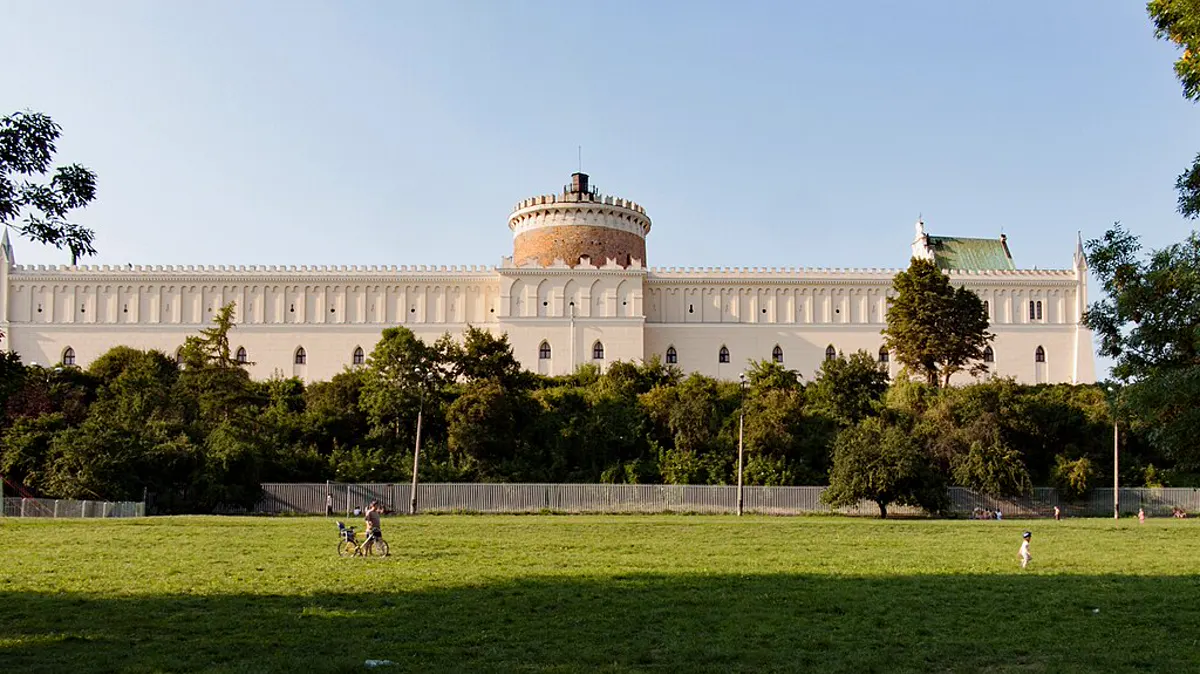
The regional capital, with a large medieval Old Town, a hilltop castle and its painted Gothic chapel, and the cuisine that gives the region its cebularz flatbread. Worth a full day.
When to visit Kazimierz Dolny
Kazimierz Dolny is at its best from late spring to early autumn, when the ferry runs, the ravines are walkable, and the square is alive. It has long been a warm-weather escape, so summer weekends are the busiest time by far.
April to May
Spring
The loess ravines green up, the Janowiec ferry restarts, and the crowds are still thin. A comfortable time for walking and for the climb to the crosses.
June to August
Summer
Warmest and busiest, with day-trippers filling the square and the Two Riversides film and art festival drawing crowds. Book a room well ahead for summer weekends.
September to October
Autumn
Golden light on the granaries and the hills turning colour, with easier walking and fewer visitors. A strong time for photography from the Three Crosses Mountain.
November to March
Winter
Quiet and often grey, with the ferry stopped and some places on shorter hours. The square and the bakeries still make a peaceful cold-weather break.
Getting to and around Kazimierz Dolny
By bus
Buses and minibuses are the main way in. Direct services run from Lublin in about two hours and from Warsaw in roughly three, with frequent local links from nearby Pulawy.
By train
Kazimierz Dolny has no station of its own. Take a train to Pulawy, about 15 km away and well connected to Warsaw and Lublin, then a local MZK Pulawy bus (lines 12 and 14) for the last stretch.
By car
From Warsaw the S17 runs to Pulawy, then a short country road drops down to the Vistula. Parking near the Market Square fills fast on summer weekends, so arrive early or use a lot on the edge of town.
By air
There is no nearby airport. Lublin (LUZ) is the closest at around 60 km, with Warsaw the usual arrival point for international visitors.
On foot
The town is tiny and made for walking, from the Market Square up to the castle ruins and the Three Crosses hill for the view over the river valley.
By the river
The Vistula sets the pace here. Seasonal pleasure boats run from the waterfront, and the riverside path and nearby gorges (wawozy) are easy walks straight from the centre.
Staying connected
- EU roaming
- If you have an EU or UK SIM, roaming works at your normal domestic rate under the roam-like-at-home rules, so most European visitors need to do nothing.
- eSIM
- For visitors from outside Europe, an eSIM from a provider such as Airalo or Holafly is the simplest option, activated before you land with no shop visit.
- Local SIM
- A prepaid SIM from Play, Orange, Plus or T-Mobile costs little and gives generous data. You need your passport to register it, which is a legal requirement.
- Free wifi
- Cafés, hotels, malls and many trams and buses have free wifi, though speeds vary. Do not rely on it for anything sensitive.
Apps to download before you go
A short list of apps that make a Polish trip smoother. Download them before you fly; every link goes straight to the app.

Jakdojade
Public transport
Public transport routes, live departure times and mobile tickets for every Polish city. The first app to install.



Bolt
Rides and taxis
The most widely used ride-hailing app in Poland, usually cheaper than a street taxi, plus e-scooters and shared bikes.

Koleo
Train tickets
Buy Polish train tickets (PKP Intercity and regional) with seat selection, often cheaper than buying at the counter.
Google Maps
Maps and offline
Reliable for walking and public-transport directions nationwide. Download the offline area for your city before you land.

Google Translate
Translation
Install the Polish language pack for offline camera translation of menus and signs.

Revolut
Payments
Hold and spend zloty at the real exchange rate, sidestepping the airport kantor and card DCC markups.

Wise
Payments
A multi-currency account and card that also spends zloty at the real exchange rate, a strong alternative to Revolut.

Booking.com
Stays
The default for hotels and apartments in Poland, with the widest choice and free-cancellation options.
Money, costs and tipping
Poland runs on the zloty, not the euro, and it is one of the better-value city-break destinations in the EU. Cards work nearly everywhere, but a few local habits save you money.
- Pay in zloty, always
- When a card machine or ATM offers to charge you in your home currency, decline it and choose PLN. That "dynamic currency conversion" hides a poor exchange rate and can add 5 to 12 percent.
- Skip airport and street exchange
- Avoid the exchange desks at the airport and the Euronet ATMs in tourist zones, which give weak rates and push DCC. Withdraw from a normal bank ATM (PKO BP, Santander, ING, Pekao) or just pay by card.
- Cash for small things
- Keep a little cash for a milk bar (bar mleczny), a market stall, a toilet (1 to 3 zl), or a rural bus. Everything else takes contactless or Apple/Google Pay.
- Tipping
- Round up or leave about 10 percent in a restaurant if you were happy. Do not say "thank you" when handing over money if you want change back, as it can be taken to mean "keep it".
Safety and local etiquette
Staying safe
Poland is one of the safer countries in Europe, and its cities feel relaxed late into the evening. The risks are the ordinary big-city ones rather than anything unusual.
- Petty theft
- Pickpocketing happens in crowded tourist spots, on packed trams and at big events. Keep your phone and wallet in a front pocket or a zipped bag and you will almost certainly be fine.
- Taxis
- Use an app (Bolt, Uber or Free Now) rather than flagging a random taxi, especially near stations and airports, to avoid inflated fares. The price is fixed and shown up front.
- Nightlife
- Stick to established bars and clubs, watch your drink, and be wary of touts steering you to a "special" venue with a surprise bill. This is rare but worth knowing.
- Emergency number
- Dial 112 for police, ambulance or fire. Operators speak English. Pharmacies (apteka) are widespread and one is always open on a rota.
Local etiquette
Poles are warm once the ice breaks and appreciate a little effort. A few points of etiquette go a long way, especially at the country's many places of memory.
- Greetings
- A firm handshake and eye contact is standard. "Dzień dobry" (good day) and "dziękuję" (thank you) are always welcome, even if the rest is in English.
- Churches and memorials
- Cover shoulders and knees in churches and keep quiet during Mass. At sites such as Auschwitz-Birkenau, dress and behave soberly, and do not take smiling selfies.
- In a home
- If you are invited to someone's home, take off your shoes at the door and bring flowers (an odd number) or chocolates. Never bring an even number of flowers, which is for funerals.
- Toasts
- Vodka is drunk cold in one go with a toast of "na zdrowie" (to health), followed by something to eat. Pace yourself, as refusing every round can seem standoffish.
Who Kazimierz Dolny suits
A quick word on who each Polish city suits and how to make it work for you.
Families
Poland is easy with children: milk bars are cheap and quick, ice cream (lody) is everywhere, and museums and parks are stroller-friendly. Trams are free for small children.
Couples
Cobbled old towns, candlelit cellar restaurants and riverside bars make for an easy romantic weekend, and prices leave room for a proper dinner out.
Solo travellers
Cities are safe and walkable, hostels are sociable, and free walking tours are a good way to meet people. English gets you a long way.
Seniors
Compact centres, plenty of cafés to rest in and good public transport make for a gentle pace. Many museums offer reduced tickets.
Accessibility
Newer trams and buses are low-floor and stations are improving, but medieval cobbles and old tenement stairs can be hard going. Check ahead for lifts.
Kazimierz Dolny: frequently asked questions
Yes, for a preserved Renaissance market town and a long-running artists' colony on the Vistula. The draws are the sloping Rynek, the ruined hilltop castle, the loess ravine walks and the galleries.
A day covers the market square, castle hill and one ravine walk. An overnight suits a slower weekend or a base for the Vistula valley.
It is about 50 km west of Lublin, roughly an hour by bus or car, or around 2.5 hours from Warsaw. There is no train station, so buses or a car are the practical options.
Yes. Summer weekends and the Two Riversides film and art festival pack this town of about 2,500 people. Midweek or the shoulder seasons are far calmer.
Local bakeries sell kogut, a rooster-shaped wheat roll that is the town's edible souvenir. You will see them stacked in windows around the Rynek.
Some gallery and restaurant staff speak English, but in a town this small do not count on it everywhere. A little basic Polish goes a long way.
Cities near Kazimierz Dolny
About this guide
This guide to Kazimierz Dolny is researched and maintained by the ViewPoland editorial team, and was last reviewed in September 2026. We update it as venues, prices and transport change.