Thematic
Skiing in Poland: Resorts, Season and How It Works
Poland's ski season runs from roughly December to March across three southern mountain areas, with terrain that suits intermediates and families far better than experts. Here is how the resorts, passes, hire and costs actually work.
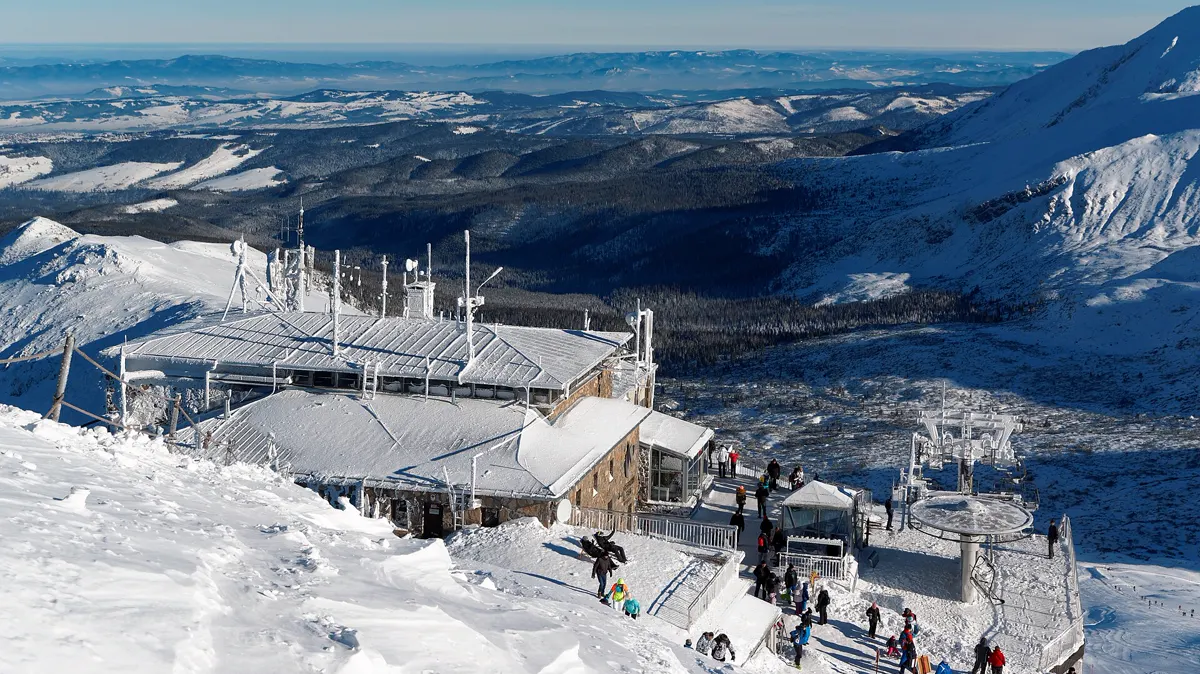
Poland's ski season runs from roughly December to March, and almost all of it happens in the south, along the ranges bordering Slovakia and the Czech Republic. Three areas matter: the Tatras around Zakopane, the Beskids west and east of Krakow, and the Karkonosze in the far southwest. The skiing suits learners, intermediates and families rather than experts, and a week generally costs far less than the Alps. Snow is the variable, not the infrastructure.
When the season runs
Most resorts open in December and close in March, though exact dates shift with the weather. Lower slopes in the Beskids and Karkonosze depend heavily on snowmaking, and a mild, wet spell can shorten the season at either end. February is usually the safer bet for cover.
Altitude explains the difference between areas. The highest lift-served terrain in the country sits on Kasprowy Wierch, whose summit reaches 1,987 metres, and in a strong winter the snow there lasts long after everything below has turned to grass. Our guide to Poland's winter weather covers what a typical January feels like.
The Tatras and Zakopane
Zakopane is the best known winter base, but the town itself has only small slopes. Nosal and Harenda are short local hills, and Gubalowka, reached by funicular from the town centre, offers gentle terrain and a long view back at the Tatra wall rather than a serious ski mountain.
The real Tatra skiing is on Kasprowy Wierch, reached by the historic cable car from Kuznice, with two chairlifts serving the Gasienicowa and Goryczkowa bowls on the far side. It sits inside Tatra National Park, so cable car capacity is capped under the park's rules and tickets can sell out. Larger, more modern lift systems lie a short drive east at Bialka Tatrzanska and Bukowina Tatrzanska. On a day off there are thermal pools such as Chocholowskie Termy, the ski jumping hill at Wielka Krokiew, and other things to do in Zakopane.
The Beskids
The Beskids are the practical choice if you are based in a city. This belt of forested ranges holds Szczyrk Mountain Resort on the Skrzyczne massif, Wisla, Korbielow beneath Pilsko, and Krynica-Zdroj, where a gondola climbs Jaworzyna Krynicka. Szczyrk was heavily rebuilt from 2017, with a ten-person gondola and new chairlifts, and is now the country's largest connected ski area.
Everything here is within reach of Katowice and Krakow, which is a mixed blessing. Weekends draw crowds from the Silesian cities, so a Tuesday is a very different mountain from a Saturday.
The Karkonosze in the southwest
The Karkonosze, known in English as the Giant Mountains, sit on the Czech border southwest of Wroclaw. The two resort towns are Szklarska Poreba, on the flanks of Szrenica, and Karpacz, where the lifts climb Kopa below Sniezka. Both offer mostly wooded runs with a good spread of easier terrain.
The range is exposed, and wind or low cloud can close the upper lifts. If you are choosing between the two ends of the country, our comparison of Zakopane or Karpacz sets out the trade-offs.
What the terrain suits
Polish pistes are dominated by blue and red runs, with modest vertical drops and short descents. That makes the country good for beginners, improving intermediates and families, and ski schools at larger resorts usually have English speaking instructors. Book lessons ahead over Christmas and the February school holidays.
Confident skiers should be realistic. There is little sustained steep piste, and the closest thing to serious freeride is the terrain around Kasprowy Wierch, avalanche ground inside a protected national park with rules on where you may go. Take a qualified local guide, carry the right kit, and check the avalanche bulletin published by TOPR, the Tatra mountain rescue service.
Lift passes and equipment hire
Passes are usually bought resort by resort, not region wide. Alongside day and half day tickets, many lifts sell points cards, where each ride deducts points, a cheap way to ski for two or three hours. A joint pass called Tatry Super Ski covers a group of resorts across Podhale and neighbouring valleys, some on the Slovak side. Check the operator's official site for current lifts and prices before buying.
Hire is easy. Shops cluster at the base stations and along the approach roads, and in Zakopane there are outlets within walking distance of Krupowki. Skis, boards, boots and helmets are standard stock, and staff at bigger shops usually speak some English. One rule to know: Polish law requires under-16s to wear a helmet on organised ski slopes.
How costs compare with the Alps
Poland is generally cheaper than the Alps across the budget: lift passes, hire, lessons, lunch on the mountain and a bed for the night. The gap tends to be widest on food and accommodation, where the range runs from a hostel bunk at Goodbye Lenin Hostel to a spa hotel such as Aries Hotel and Spa. Our overview of whether Poland is expensive gives the wider picture.
What you give up is scale and snow reliability. Ski areas are smaller, vertical is shorter, and the lower resorts lean on snow cannons. For a first ski trip, a family week or a few days added to a city break, that trade works. For a fortnight of big mountain skiing, it does not. Prices are quoted in zloty, so read up on how currency works in Poland before you go.
Good to know
The cable car to Kasprowy Wierch runs inside a national park, so its capacity is capped and winter slots can sell out. Book through the operator's official website in advance rather than turning up at Kuznice and hoping.
Written by ViewPoland Editorial for ViewPoland, an independent English-language guide to Poland. Published 2 August 2026. Last updated 2 August 2026.