The complete guide · Podlasie
Białowieża
The village at the edge of Europe's last great primeval lowland forest, home to the continent's largest wild population of European bison.
Overview
Bialowieza is a village on the eastern edge of Poland, in Podlaskie, pressed right up against the Belarusian border. Its name means white tower, after a royal hunting lodge that once stood in the forest. That forest is the reason to come: the Bialowieza Forest is the last large fragment of the lowland primeval woodland that once covered much of the European plain, and its best-preserved Polish core is protected as Bialowieza National Park. Created in 1932, it is the oldest national park in the country, and UNESCO listed the forest in 1979.
The animal everyone associates with the place is the European bison, the zubr, the heaviest land mammal on the continent. Hunted to extinction in the wild in the early 20th century, it was bred back from a handful of survivors and released here, and the forest now holds the largest free-living herd in the world. The park's strictly protected core, around 47 square kilometres of untouched forest, can only be entered on foot with a licensed guide, walking a fixed route. Everything else, the cycling trails, the show reserve, the birdwatching hides, you can do on your own.
The village itself is small, roughly 2,000 people, strung along a single main road with the Palace Park at its centre. Reaching it takes some planning. There is no motorway and no nearby airport, so most visitors drive from Warsaw, about four hours, or take a train to Hajnowka and continue the last stretch by bus, taxi, or bike. Give it at least two days: one for the guided walk into the strict reserve, one for the bison and the trails.
Białowieża at a glance
Airport
No local airport; Warsaw Chopin (WAW) is roughly 240 km west, with Bialystok the nearest sizeable city about 85 km away
Population
About 2,000
Founded
National park established 1932 (forest protected from 1921)
Good to know
Poland's oldest national park and last stretch of European lowland primeval forest, UNESCO listed, home to the largest wild herd of European bison
Currency
Polish zloty (PLN, zl). Not the euro.
Language
Polish. English is widely spoken in tourism and by younger people.
Time zone
Central European Time (UTC+1, or UTC+2 in summer).
Emergency
112 from any phone, free, English-speaking operators.
Tap water
Safe to drink everywhere in Poland.
Cards
Contactless is accepted almost everywhere, even for small amounts.
Sockets
Type E, 230V. UK and US visitors need an adapter.
Visas
Poland is in the Schengen Area and uses the EU entry rules.
Top things to see in Białowieża
Palace Park (Park Pałacowy)
Landscaped grounds around the site of the tsars' burned hunting palace, now the setting for the national park museum.
Orthodox Church of St Nicholas
A tsarist-era Orthodox church holding a rare glazed-ceramic iconostasis, unusual in Poland.
Strict Nature Reserve, Białowieża (Guided Primeval Forest Walk)
The strictly protected core of the Białowieża primeval forest, a UNESCO World Heritage site entered only on foot with a licensed park guide. Visitors...
Royal Oaks Trail (Szlak Dębów Królewskich)
A short boardwalk loop in the Stara Białowieża tract that winds past monumental oaks, each named after a Polish king or Lithuanian duke who once hunte...
Białowieża Towarowa Railway Station
A restored 1903 freight railway station on the edge of Białowieża village, now home to a Tsarist-themed venue and accommodation set inside its old dep...
Białowieża Pałac Railway Station
A restored 19th-century railway station in Białowieża that once served the Russian tsar's hunting palace and now houses a family education-and-play co...
Open-Air Museum (Skansen) in Białowieża
An open-air folk-architecture museum in Białowieża village that gathers traditional wooden rural buildings of the region, including dwellings, a barn,...
Białowieża Handcars (Draisines)
Hand-powered railway trolleys that visitors pedal along a disused line running towards Białowieża, passing through forest and meadow. Groups power the...
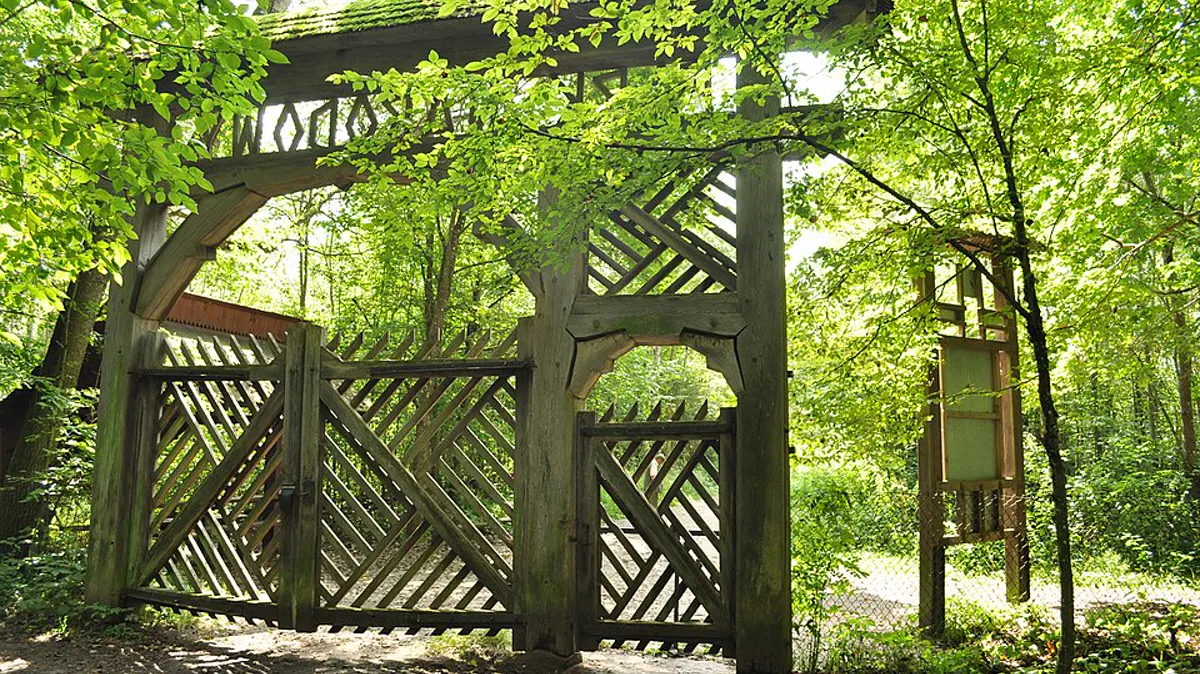
Palace Gate (Tsar's Palace Gate)
A red-brick gatehouse from the 1890s that marked the entrance to Tsar Alexander III's hunting estate in Białowieża, and one of the few structures left...
Museums, castles and nature in Białowieża
Museums
Nature and Forest Museum (Muzeum Przyrodniczo-Leśne)
The national park's natural-history museum in Palace Park, with forest dioramas and a viewing tower.
Parks and nature
Bialowieza National Park
A fragment of primeval lowland forest, never logged in its core, protecting Europe's largest wild population of bison.
European Bison Show Reserve
A managed enclosure west of the village where you can reliably see European bison along with wolves, lynx and elk.
Where to base yourself: the neighbourhoods
Park Palacowy (Palace Park)
The green heart of the village, laid out in the 1890s around a Tsar's hunting palace that burned in 1944 and was later demolished. The park keeps its ponds, avenues, and pavilions, and holds the national park's administration and the Nature and Forest Museum.
The village centre
A low, quiet settlement along ul. Waszkiewicza and the main road, lined with guesthouses, agritourism farms, a couple of restaurants, and the wooden Orthodox and Catholic churches that reflect the region's mixed heritage. This is where almost everyone stays.
Strict Protection Area (Obszar Ochrony Scislej)
The fenced primeval core of the national park, entered only with a licensed guide on a set path. Ancient oaks, hornbeams, and dead standing timber left to rot naturally show what a European forest looked like before forestry.
European Bison Show Reserve (Rezerwat Pokazowy Zubrow)
A large enclosure about 3 km before the village on the road from Hajnowka, where bison and other forest animals live in near-natural conditions. The reliable way to see zubr up close without waiting for luck on the trails.
Narewka
A village at the northern edge of the forest, a popular starting point for birdwatching and cycling trips. Handy for reaching the Siemianowka Reservoir and the quieter northern woods.
Hajnowka
The gateway town about 17 km west, the end of the passenger rail line and the main road approach. Worth a stop for its large modern Orthodox Cathedral of the Holy Trinity before you press on into the forest.
How to spend one, two or three days in Białowieża
Day 1
Into the primeval forest
- Morning: Book a licensed guide in advance, then walk the Strict Protection Area. Groups are small and stay on one path through untouched forest of towering oaks, spruce, and fallen giants left where they lie. Expect two to three hours at a slow pace.
- Afternoon: Cross into the Palace Park and visit the Nature and Forest Museum for the context on the forest's ecology and history, then climb its viewing tower. Wander the ponds and avenues where the Tsar's palace once stood.
- Evening: Eat in the village. Look for regional Podlasie cooking, potato dishes and forest mushrooms, and try a glass of Zubrowka, the bison-grass vodka tied to this forest.
Day 2
Bison, bikes, and birds
- Morning: Drive or cycle to the European Bison Show Reserve to see zubr, along with elk, deer, wild boar, wolves, lynx, and konik horses in large enclosures. Early morning is best for active animals.
- Afternoon: Follow one of the marked forest cycling or walking trails outside the strict reserve, such as the routes toward Narewka or the old oak avenues. Bikes rent easily in the village.
- Evening: Join a dawn or dusk wildlife watch if you can, or simply walk the forest edge at sunset, when bison sometimes graze the meadows and the birdlife is loudest.
Day 3
Around Podlasie
- Morning: Head to the Siemianowka Reservoir north of the forest, one of the region's best birdwatching spots, with eagles, storks, cranes, and terns over the water and reeds.
- Afternoon: Drive to Kruszyniany to see the wooden Tatar mosque, the oldest in Poland, and its Muslim cemetery, a trace of the Lipka Tatars settled here in the 17th century. Local Tatar food is served nearby.
- Evening: Return via Hajnowka, pausing at its Orthodox cathedral, then back to Bialowieza for a last quiet night at the forest edge.
Where to eat and drink in Białowieża
Start with what the region does best: Zubrowka, Kartacze, Babka and kiszka ziemniaczana and Forest mushrooms and game.
Restauracja Pokusa
A broad-menu Białowieża restaurant strong on game, fish and regional dishes with craft beer.
Restauracja Stoczek 1929
A traditional Eastern European restaurant on Stoczek known for pierogi and a fireplace-warmed room.
Kartoszka
A café-restaurant on the main street serving Podlaskie potato dishes and coffee all day.
Syrenka
A small Białowieża café pouring single-origin coffee with homemade apple pie and muffins.
Where to stay in Białowieża
Hotel Żubrówka Spa & Wellness
A four-star spa hotel by the national park entrance with pool, salt cave and a regional restaurant.
Hotel Białowieski Conference, Wellness & SPA
A three-star forest-edge hotel with an indoor pool, spa and its own on-site brewery.
What to eat and drink in Białowieża
Local to Białowieża
Zubrowka
The bison-grass vodka flavoured with a blade of sweetgrass from the Bialowieza Forest, giving it a soft herbal note. Locally it is drunk neat or in the apple-juice mix known as tatanka.
Kartacze
Large potato dumplings stuffed with seasoned minced meat, a filling Podlasie staple also called cepeliny. Usually served with fried onion and pork crackling.
Babka and kiszka ziemniaczana
Baked grated-potato pudding (babka) and potato sausage (kiszka), two hearty Podlasie classics built on the region's potatoes. Simple, rich country food served with sour cream.
Forest mushrooms and game
The woods supply wild mushrooms, berries, and game that turn up in soups, sauces, and pierogi across village kitchens. Autumn menus lean heavily on the forest harvest.
Sekacz
The tall, branched Podlasie tree cake, baked layer by layer over an open flame into a spiky golden cone. A festive regional sweet sold across the north-east.
Polish classics worth ordering
Polish cooking is hearty, seasonal and built on soups, dumplings and slow-cooked meat. These are the classics worth seeking out in any city, best at a milk bar or an old-school restaurant rather than a tourist trap.
Pierogi
Half-moon dumplings stuffed with anything from potato and curd cheese (ruskie) to meat, cabbage and mushroom, or sweet fruit. Boiled or pan-fried in butter.
Żurek
A tangy soup of soured rye flour, usually with white sausage and a boiled egg, sometimes served in a bread bowl. The taste of a Polish Easter.
Bigos
The "hunter's stew" of sauerkraut, fresh cabbage and several meats, simmered for days until deep and smoky. Better the second day.
Kotlet schabowy
A breaded, flattened pork cutlet, the Polish Sunday dinner, served with potatoes and mizeria (cucumber in cream) or cabbage.
Gołąbki
Cabbage leaves rolled around minced meat and rice, baked in a tomato or mushroom sauce. The name means "little pigeons".
Placki ziemniaczane
Crisp potato pancakes, eaten savoury with sour cream or, in the mountains, drowned in a goulash (placki po zbojnicku).
Rosol
A clear, golden chicken broth with fine noodles, the traditional start to a Polish Sunday lunch.
Sernik and paczki
For something sweet: sernik (a dense baked cheesecake made with twarog curd) and paczki (rose-jam doughnuts), devoured by the million on Fat Thursday.
Drinks
Poland is a vodka country first, but it also has a serious craft-beer scene and a tradition of homemade fruit liqueurs.
- Wodka
- Drunk cold and neat, in company, with a toast and a bite to follow. Clean rye or potato brands (Belvedere, Chopin, Wyborowa) are the benchmark.
- Nalewki
- Homemade fruit and herb liqueurs, from cherry (wisniowka) to honey-spiced krupnik, often stronger and smoother than they look.
- Craft beer
- Poland has hundreds of craft breweries and multitap bars in every city. Ask for a local piwo rzemieslnicze rather than the mass lagers.
- Non-alcoholic
- Kompot (a jug of stewed fruit) is the homemade soft drink, and in winter grzane piwo (mulled beer) and grzaniec (mulled wine) warm up the markets.
Best day trips from Białowieża
Hajnowka
17 km · 25 min by car
The gateway town and rail terminus, best known for its large modern Orthodox Cathedral of the Holy Trinity, a centre of Orthodox church music. A practical stop for shops and transport connections.
Siemianowka Reservoir
35 km · 45 min by car
A broad artificial lake on the Narew north of the forest, one of the finest birdwatching sites in the region. Watch for white-tailed eagles, black storks, cranes, and large tern colonies.
Kruszyniany
55 km · 1 h 10 min by car
A village of the Lipka Tatars with the oldest wooden mosque in Poland and an old Muslim cemetery in the woods behind it. Family-run kitchens serve traditional Tatar dishes.
Narew and the marshes
40 km · 50 min by car
The wide, braided Narew river valley and its wetlands north-west of the forest, sometimes called the Polish Amazon for its shifting channels. Prime territory for birds and quiet paddling.
Bialystok
85 km · 1 h 20 min by car
The regional capital, built around the Baroque Branicki Palace and its French-style gardens. The nearest city for a full range of hotels, museums, and onward trains.
Bialowieza Forest cycling loops
From the village
A network of marked forest trails and old railway routes fans out from the village toward Topilo and the narrow-gauge tourist line. An easy way to reach quieter parts of the forest under your own power.
When to visit Białowieża
Bialowieza is a year-round destination, but the forest changes hard with the seasons and each suits a different visitor. Spring is for birds and fresh growth, autumn for the bison rut and colour, winter for tracking animals in snow.
April to June
Spring
The best time for birdsong and wildflowers, with the forest waking up and migrant species arriving. Cool mornings are ideal for the guided walk, and the crowds are thin outside weekends.
July to August
Summer
Warm, green, and busiest, with the show reserve, museum, and cycling trails at their liveliest. Book accommodation and guides ahead, and bring protection against mosquitoes in the damp woods.
September to October
Autumn
The bison rut brings big animals into the open, and the hornbeams and oaks turn gold. Crisp light and fewer people make this a strong season for photography and wildlife.
November to March
Winter
Cold and often snowbound, but tracks in the snow make bison and wolves easier to trace, and the forest is at its most silent. Bison gather near feeding sites, and days are short, so plan accordingly.
Getting to and around Białowieża
By train
Bialowieza village has no station of its own. The nearest railhead is Hajnowka, about 20 km away, reached by direct trains from Warszawa Zachodnia (roughly 4 to 5 hours) or via Bialystok for more departure choices.
By bus
From Hajnowka a couple of local buses a day cover the last stretch to Bialowieza, so times are limited. Many guesthouses arrange a pickup from Hajnowka, which is worth booking ahead.
By car
Driving is the most flexible option in this remote corner near the Belarus border. From Bialystok take the DK19 and DK685 to Hajnowka, then the road 689 into the forest; Warsaw is about a 3.5 to 4 hour drive.
By air
There is no airport anywhere near. Warsaw is the realistic arrival point, from where it is a long train-and-bus or road trip east into the Bialowieza Forest.
On foot & guided
The village is small and walkable, and the strictly protected core of the primeval forest can only be entered on a guided walk booked through the National Park.
By bike
Bikes are the local way to reach the forest trails, the European bison show reserve and the marked routes around the village. Rentals are easy to find in season.
Staying connected
- EU roaming
- If you have an EU or UK SIM, roaming works at your normal domestic rate under the roam-like-at-home rules, so most European visitors need to do nothing.
- eSIM
- For visitors from outside Europe, an eSIM from a provider such as Airalo or Holafly is the simplest option, activated before you land with no shop visit.
- Local SIM
- A prepaid SIM from Play, Orange, Plus or T-Mobile costs little and gives generous data. You need your passport to register it, which is a legal requirement.
- Free wifi
- Cafés, hotels, malls and many trams and buses have free wifi, though speeds vary. Do not rely on it for anything sensitive.
Apps to download before you go
A short list of apps that make a Polish trip smoother. Download them before you fly; every link goes straight to the app.

Jakdojade
Public transport
Public transport routes, live departure times and mobile tickets for every Polish city. The first app to install.



Bolt
Rides and taxis
The most widely used ride-hailing app in Poland, usually cheaper than a street taxi, plus e-scooters and shared bikes.

Koleo
Train tickets
Buy Polish train tickets (PKP Intercity and regional) with seat selection, often cheaper than buying at the counter.
Google Maps
Maps and offline
Reliable for walking and public-transport directions nationwide. Download the offline area for your city before you land.

Google Translate
Translation
Install the Polish language pack for offline camera translation of menus and signs.

Revolut
Payments
Hold and spend zloty at the real exchange rate, sidestepping the airport kantor and card DCC markups.

Wise
Payments
A multi-currency account and card that also spends zloty at the real exchange rate, a strong alternative to Revolut.

Booking.com
Stays
The default for hotels and apartments in Poland, with the widest choice and free-cancellation options.
Money, costs and tipping
Poland runs on the zloty, not the euro, and it is one of the better-value city-break destinations in the EU. Cards work nearly everywhere, but a few local habits save you money.
- Pay in zloty, always
- When a card machine or ATM offers to charge you in your home currency, decline it and choose PLN. That "dynamic currency conversion" hides a poor exchange rate and can add 5 to 12 percent.
- Skip airport and street exchange
- Avoid the exchange desks at the airport and the Euronet ATMs in tourist zones, which give weak rates and push DCC. Withdraw from a normal bank ATM (PKO BP, Santander, ING, Pekao) or just pay by card.
- Cash for small things
- Keep a little cash for a milk bar (bar mleczny), a market stall, a toilet (1 to 3 zl), or a rural bus. Everything else takes contactless or Apple/Google Pay.
- Tipping
- Round up or leave about 10 percent in a restaurant if you were happy. Do not say "thank you" when handing over money if you want change back, as it can be taken to mean "keep it".
Safety and local etiquette
Staying safe
Poland is one of the safer countries in Europe, and its cities feel relaxed late into the evening. The risks are the ordinary big-city ones rather than anything unusual.
- Petty theft
- Pickpocketing happens in crowded tourist spots, on packed trams and at big events. Keep your phone and wallet in a front pocket or a zipped bag and you will almost certainly be fine.
- Taxis
- Use an app (Bolt, Uber or Free Now) rather than flagging a random taxi, especially near stations and airports, to avoid inflated fares. The price is fixed and shown up front.
- Nightlife
- Stick to established bars and clubs, watch your drink, and be wary of touts steering you to a "special" venue with a surprise bill. This is rare but worth knowing.
- Emergency number
- Dial 112 for police, ambulance or fire. Operators speak English. Pharmacies (apteka) are widespread and one is always open on a rota.
Local etiquette
Poles are warm once the ice breaks and appreciate a little effort. A few points of etiquette go a long way, especially at the country's many places of memory.
- Greetings
- A firm handshake and eye contact is standard. "Dzień dobry" (good day) and "dziękuję" (thank you) are always welcome, even if the rest is in English.
- Churches and memorials
- Cover shoulders and knees in churches and keep quiet during Mass. At sites such as Auschwitz-Birkenau, dress and behave soberly, and do not take smiling selfies.
- In a home
- If you are invited to someone's home, take off your shoes at the door and bring flowers (an odd number) or chocolates. Never bring an even number of flowers, which is for funerals.
- Toasts
- Vodka is drunk cold in one go with a toast of "na zdrowie" (to health), followed by something to eat. Pace yourself, as refusing every round can seem standoffish.
Who Białowieża suits
A quick word on who each Polish city suits and how to make it work for you.
Families
Poland is easy with children: milk bars are cheap and quick, ice cream (lody) is everywhere, and museums and parks are stroller-friendly. Trams are free for small children.
Couples
Cobbled old towns, candlelit cellar restaurants and riverside bars make for an easy romantic weekend, and prices leave room for a proper dinner out.
Solo travellers
Cities are safe and walkable, hostels are sociable, and free walking tours are a good way to meet people. English gets you a long way.
Seniors
Compact centres, plenty of cafés to rest in and good public transport make for a gentle pace. Many museums offer reduced tickets.
Accessibility
Newer trams and buses are low-floor and stations are improving, but medieval cobbles and old tenement stairs can be hard going. Check ahead for lifts.
Białowieża: frequently asked questions
Not in the wild, where sightings take luck, patience and usually a dawn guide. The European Bison Show Reserve near the village keeps bison and other forest animals in large enclosures, so a look is guaranteed there.
Only for the strictly protected core of the national park, which you enter on foot with a licensed guide on a fixed route. The cycling loops, birdwatching hides and show reserve you can do on your own.
There is no nearby airport or motorway. Most visitors drive from Warsaw in about four hours, or take a train to Hajnowka and cover the last 17 km by bus, taxi or bike.
At least two: one for the guided walk into the strict reserve, and one for the bison show reserve, the trails and the birdwatching. The remote logistics reward a slower pace.
Late autumn through winter, when herds gather at forest edges and feeding sites and the bare trees improve visibility. A licensed guide greatly raises your chances at any time of year.
For nature-minded travelers, yes. It protects the last large stretch of European lowland primeval forest, a UNESCO site, and holds the world's largest wild herd of European bison. Just plan the travel carefully.
Licensed nature guides and most lodges speak English, but this is a small border village, so arrange guided walks and tours ahead of time.
Cities near Białowieża
About this guide
This guide to Białowieża is researched and maintained by the ViewPoland editorial team, and was last reviewed in September 2026. We update it as venues, prices and transport change.