Thematic in Warsaw
How Was Warsaw Rebuilt After the War? The Short History
Most of Warsaw's Old Town was rebuilt after the war, and the rebuilding itself is part of why UNESCO put it on the World Heritage List.
By ViewPoland Editorial
5 min read
Updated September 2026
The short answer
Warsaw was deliberately destroyed in 1944 as a reprisal for resistance to the German occupation, and its historic centre was 85% ruined. It was rebuilt in its historic form thanks to its residents and help from the whole nation, and UNESCO listed the Historic Centre of Warsaw in 1980.
Visitors who walk into Warsaw's Old Town are often surprised to learn that most of what they are looking at was rebuilt after the war, reusing the structures that survived. Knowing that changes how the place reads: less a medieval town than a deliberate act of national recovery.
How badly was Warsaw destroyed in the Second World War?
Poland's National Heritage Board states that in 1944 Warsaw was deliberately annihilated as a reprisal for the resistance put up against the German occupation, and that reducing the capital to ruins was meant to cut off centuries of Polish statehood. The historic city was destroyed in 85%.
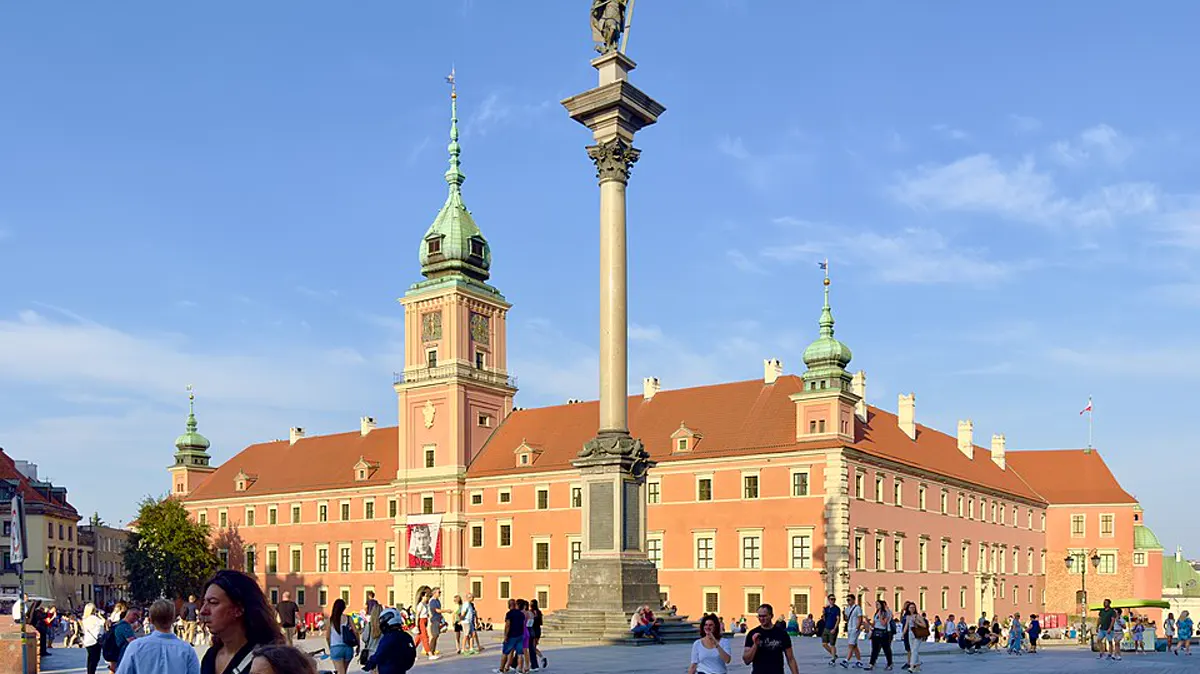
The Royal Castle shows the sequence clearly. According to the castle, it was bombed in September 1939, when museum staff led by Professor Stanisław Lorentz managed to save some interior fittings and works of art. In September 1944 it was blown up by German troops.
Is Warsaw Old Town original or rebuilt?
Mostly rebuilt. The National Heritage Board describes the reconstruction of the Old Town in its historic urban and architectural form as an expression of care for the survival of one of the most important testimonies of Polish culture, and says the rebuilding of the historic city was made possible by the determination of its residents and help from the whole nation. The plan, drawn up in the Bureau for the Reconstruction of the Capital between 1945 and 1951, reused structures from the 14th to the 18th centuries that had survived the fighting, together with the late medieval street grid, its squares and market square, and the ring of city walls.
That is the key difference from Kraków, whose centre survived the war and is original, as we explain in what Krakow is famous for. The two cities are compared directly in Krakow or Warsaw.
Why is a rebuilt Old Town a UNESCO World Heritage Site?
Because of what the reconstruction changed. The Historic Centre of Warsaw was inscribed on the World Heritage List in 1980. The National Heritage Board notes that the rebuilding of Warsaw's historic centre became a leading factor in changing the doctrines of urban planning and heritage conservation in most European countries after the destruction of the Second World War.
In other words, the listing recognises the rebuilding itself, not the age of the bricks. You can walk the result on the Old Town Market Square.
When was the Royal Castle in Warsaw rebuilt?
Much later than the Old Town around it. The castle states that between 1945 and 1970 the communist authorities delayed its reconstruction, and the decision was only taken in 1971. Until 1980 the rebuilding was funded entirely by public donations. The reconstructed interiors opened to visitors in 1984.
The work did not stop there. In 2013 the castle's eastern facade was restored to the appearance known from the paintings of Bernardo Bellotto, called Canaletto, and the completion of the lower garden in 2019 marked the end of the restoration of the castle complex. Our page on the Royal Castle in Warsaw covers visiting it.
What records were used to rebuild Warsaw?
The National Heritage Board says the rebuilding followed two main principles: to use reliable archival documents, and to recreate the image of the historic city at the end of the 18th century. The plan depended on detailed iconographic material and historical documentation from that period, and it also used conservation inventories made before 1939 and after 1944.
The archive of the Bureau for the Reconstruction of the Capital, known by its Polish initials BOS, documents both the rebuilding of Warsaw after the Second World War and its near-total destruction between 1939 and 1945. It was entered on UNESCO's Memory of the World Register in 2011 and is held by the State Archive in Warsaw.
Where can you see the story of the rebuilding today?
Start at the Royal Castle, which holds, in a room designed for a Polish king, a set of 22 views of Warsaw and its surroundings by Bernardo Bellotto, called Canaletto, described by the castle as the largest surviving series of his paintings. Then walk out into the Old Town and its market square. Things to do in Warsaw places both in a first day, and the Warsaw guide covers the rest of the city.
Sources
National Heritage Board of Poland, Historic Centre of Warsaw for the destruction in 1944, the 85% figure, the reconstruction plan of 1945 to 1951, the documents it used, its influence and the 1980 inscription. Royal Castle in Warsaw, history for the castle's destruction and rebuilding dates. Royal Castle in Warsaw, Bernardo Bellotto for the 22 views and the painter's name in Poland. Polish National Commission for UNESCO, Memory of the World for the BOS archive.
Written by ViewPoland Editorial for ViewPoland, an independent English-language guide to Poland. Published 27 September 2026. Last updated 27 September 2026.
Frequently asked questions
The historic city was destroyed in 85%, according to Poland's National Heritage Board, which also states that Warsaw was deliberately annihilated in 1944 as a reprisal for resistance to the occupation.
Yes. The Historic Centre of Warsaw was inscribed in 1980, and the listing reflects the significance of the reconstruction, which influenced heritage conservation across Europe after the war.
The decision to rebuild was only taken in 1971, after years of delay, and the reconstructed interiors opened to visitors in 1984. Restoration of the whole complex was completed in 2019.
Until 1980 the rebuilding was funded entirely by public donations, according to the castle.
The archive of the Bureau for the Reconstruction of the Capital, which documents both the destruction of Warsaw in 1939 to 1945 and its rebuilding after the war. It was entered on UNESCO's Memory of the World Register in 2011 and is held by the State Archive in Warsaw.
At the Royal Castle in Warsaw, which holds a set of 22 of his views of the city and its surroundings, described by the castle as the largest surviving series of his paintings. In Poland he is called Canaletto.