Thematic in Kraków
What Is Krakow Famous For? The Nine Reasons People Go
Krakow is famous for one thing above all: it is the Polish city the Second World War did not flatten.
By ViewPoland Editorial
4 min read
Updated August 2026
The short answer
Krakow is famous for having survived. Its medieval centre is original rather than reconstructed, which is why UNESCO listed it in 1978. Add Wawel Castle, the largest market square of medieval Europe, the Kazimierz Jewish quarter, a salt mine, a dragon and Poland's oldest university.
Almost everything Krakow is known for follows from one fact. Warsaw was destroyed and rebuilt, and Krakow was not, so the country's medieval and royal past is concentrated in one walkable city rather than spread thinly across a rebuilt one.
A centre that is original
The Historic Centre of Kraków entered the UNESCO World Heritage List in 1978, among the first sites inscribed anywhere. The listing covers three separate urban units: the medieval chartered city, the Wawel Hill complex, and the town of Kazimierz with the Stradom suburb. The buildings, the street plan and the fittings are the ones that were there. Whether that is enough to justify the trip is the question we answer in is Krakow worth visiting.
The Main Market Square
UNESCO describes Rynek Główny as the largest market square of medieval Europe. The Cloth Hall runs down the middle of it, a covered trading arcade that has been selling things continuously for centuries. On the hour, a trumpet call sounds from the tower of St Mary's Basilica and breaks off mid-phrase, which is the most Krakow thing that happens all day. See our pages on the Main Market Square and Kazimierz.
Wawel, the royal hill
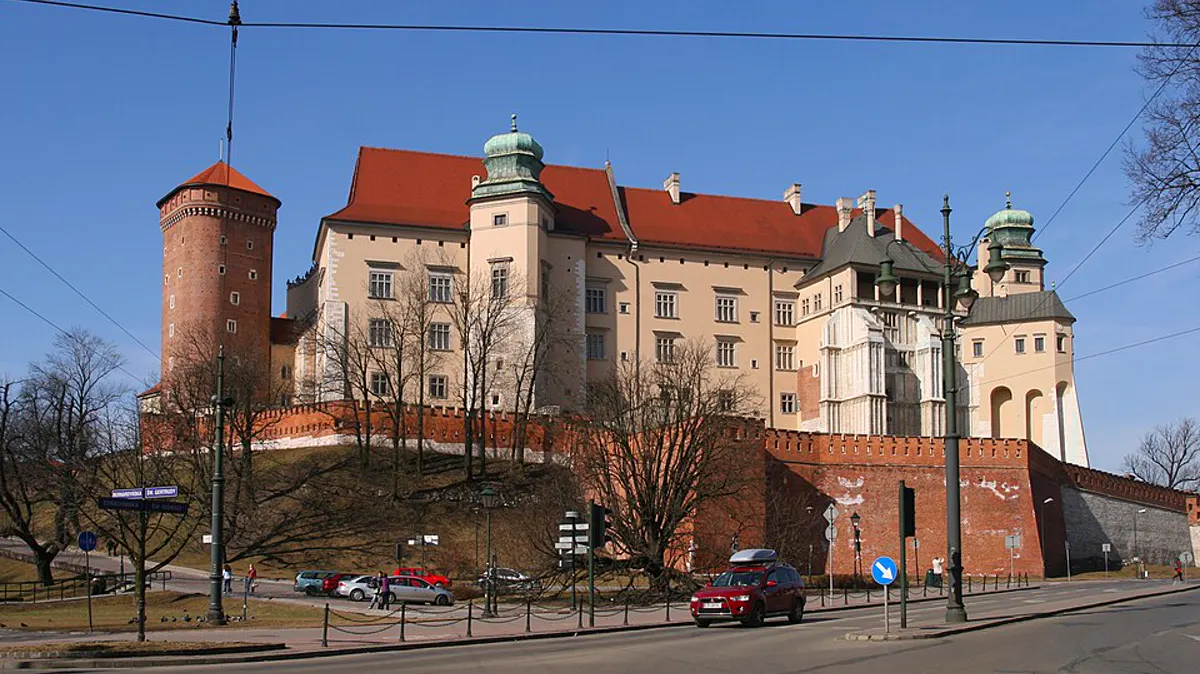
Wawel is where Polish kings were crowned and buried, and it carries the political weight that Westminster does in England. The full story is in was Krakow the capital of Poland. The cathedral holds the royal tombs, the castle holds the state rooms and the Renaissance courtyard, and the hill itself is free to walk up. Our Wawel visitor guide covers what is worth a ticket.
Kazimierz and the Jewish past
Kazimierz was chartered as its own town in 1335 and became one of the most important centres of Jewish life in Europe. Its synagogues, cemeteries and street plan survived, and the district was largely emptied of its people in the Second World War. What visitors encounter now is a place holding both facts at once, which is why it feels unlike the Old Town twenty minutes away. The three districts are usually walked, but a cart tour links them in under an hour.
The salt mine and the dragon
The Wieliczka Salt Mine, on the edge of the city, is a working monument with a cathedral carved from salt inside it, and it holds its own UNESCO listing. The Wawel dragon is the city's founding legend, a beast under the castle hill killed by a trick rather than a sword, and the sculpture at the mouth of its cave breathes fire at intervals. One is a serious industrial monument and the other is for children, and Krakow is comfortable with both.
A very old university, and Copernicus
The Jagiellonian University was founded in the fourteenth century and is among the oldest in Europe. Nicolaus Copernicus studied here. So did Karol Wojtyła, later Pope John Paul II, who was Archbishop of Krakow before his election, which is a large part of why the city matters to Catholic visitors.
What Krakow is not famous for, but should be
Nowa Huta, the planned socialist steel town built on the eastern edge in the 1940s and 1950s, is one of the most complete pieces of communist urban design anywhere and almost nobody visits it. The food is the other underrated part, and our restaurants guide makes the case.
Sources
UNESCO World Heritage Centre, Historic Centre of Kraków for the 1978 inscription, the three urban units, the description of the market square and the chartering of Kazimierz in 1335. Jagiellonian University for its own history. Kraków official tourism portal for the sights.
Written by ViewPoland Editorial for ViewPoland, an independent English-language guide to Poland. Published 28 August 2026. Last updated 27 September 2026.
Frequently asked questions
For having a medieval centre that survived the Second World War intact, unlike Warsaw. That single fact underpins the UNESCO listing, the concentration of original buildings and the city's role as the place people go to see old Poland.
The Historic Centre of Krakow was inscribed in 1978 for its density of monuments preserved in their original form. The listing covers the medieval city, Wawel Hill and the former town of Kazimierz including Stradom.
UNESCO describes it as the largest market square of medieval Europe. It holds the Cloth Hall trading arcade and St Mary's Basilica, from whose tower a trumpet call sounds every hour and breaks off mid-phrase.
Yes, for centuries, and Wawel was where kings were crowned and buried. The court later moved to Warsaw, but the coronations and the royal tombs stayed in Krakow.
Pierogi, obwarzanek, the ring-shaped bread sold from street carts and protected as a regional speciality, zapiekanka from Plac Nowy in Kazimierz, and the milk bars, which are cheap canteens surviving from the communist period.
The city's founding legend places a dragon in a cave beneath Wawel Hill, killed not in battle but by a trick. The cave is real and can be visited, and a metal sculpture at its mouth breathes fire.