The short answer
Snow in Zakopane is never guaranteed. The town sits at the foot of the Tatras, where rain is more common than higher up, and snow becomes more likely the higher you go. January and February are the coldest months. For today, check the Tatra National Park weather page and the avalanche bulletin.
People ask this question in two ways. Some want to know whether the town will look like a winter postcard when they arrive. Others want to know whether there is enough snow on the mountains to ski or hike. The answer is different for each, because a few hundred metres of altitude change the weather more than a few weeks of the calendar.
Is there snow in Zakopane right now?
No guide can answer that honestly, including this one. Conditions in the Tatras change within days. The two sources worth checking on the morning you travel are the weather page run by Tatra National Park and the avalanche bulletin that TOPR, the Tatra mountain rescue service, publishes on its own site, which the park links to from its website.
The avalanche bulletin is the more telling of the two, because it describes the general level of avalanche danger for the day. TOPR is explicit that the information in it is a basis for your own assessment and does not replace your own judgement of the local avalanche situation.
Why does Zakopane get rain when the Tatras get snow?
Tatra National Park describes the pattern plainly. The mean annual air temperature at the foot of the Tatras is about 6°C, while in the highest parts of the range it falls to about minus 4°C. Temperature drops by roughly 0.5°C for every 100 metres you climb. In the lower parts of the mountains rain is the more common form of precipitation, and the share of snow grows with altitude until it dominates near the summits.
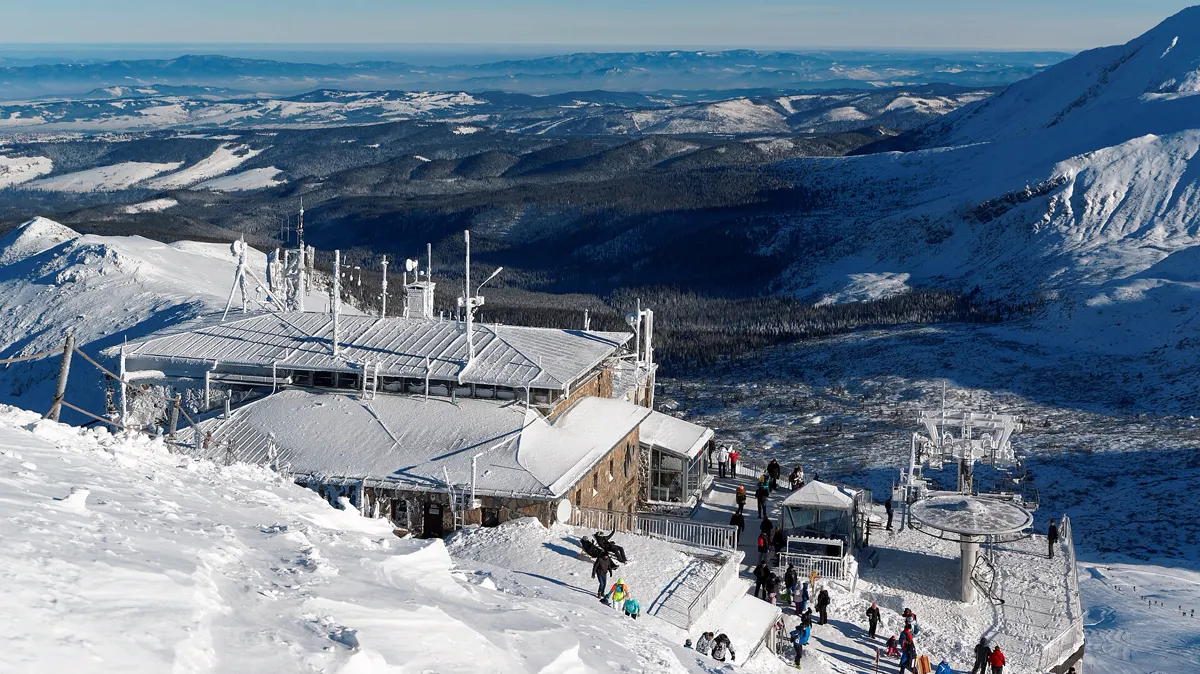
Precipitation rises with height too. The park gives an annual total of about 1,200 mm at the foot of the mountains and almost 1,800 mm on Kasprowy Wierch. So a wet, grey day on Krupówki can be a snowy day at the top of the cable car.
How high is Zakopane above sea level?
Zakopane is the highest-located town in Poland, and its administrative boundary takes in part of the Tatras. The highest point inside the town limits is the summit of Świnica at 2,301 metres, so the town is less a single altitude than a slope running from the valley up into the high mountains.
The easiest way to feel that difference is the cable car to
Kasprowy Wierch. According to the national park, it covers 4,291.59 metres of line and climbs 936 metres, arriving at an upper station 1,959 metres above sea level. At the park's rate of about half a degree per 100 metres, that climb alone accounts for several degrees of cooling.
Which months are coldest in Zakopane?
January and February. Tatra National Park names them as the months with the lowest temperatures, which makes them the safest bet if seeing snow is the point of the trip.
No official source publishes a month-by-month guarantee of snow for the town itself, and you should be wary of any that does. What the park's figures do support is a simple rule: the colder the month and the higher you are, the better your chances.
What is Zakopane like in October, November, March and April?
In these months, what you see depends on how high you go more than on the date. If you are travelling for mountain views, plan on going up rather than expecting snow in the streets, but check the cable car first: the national park notes that Kasprowy Wierch is closed for inspections every May and November.
Whether these months suit your trip for other reasons is weighed up in
is Zakopane worth visiting.
Are the Tatra trails closed when there is snow?
Most are not, but some are. A guide by Adam Marasek, an experienced TOPR rescuer, published on the Tatra National Park website, states that trails in the Polish Tatras are not closed apart from a few exceptions. For nature protection the park closes three for the whole period from 1 December to 15 May: Morskie Oko to Świstówka and the Valley of Five Polish Ponds, the trail to Czerwone Wierchy from Dolina Tomanowa to Chuda Przełączka, and the trail to Giewont from Przełęcz w Grzybowcu to Przełęcz Kondracka Wyżnia. The park may also close other trails or areas when there are particular hazards.
The same guide says that each walker decides whether to go and carries the consequences, and warns that winter trails are often completely buried, with someone else's tracks no guarantee of a safe route. The mountain rescue numbers are 985 and 601 100 300. If skiing rather than walking is the plan, our
guide to skiing in Poland covers the resorts and the season.
What should you pack for snow in Zakopane?
Pack for both climates. Waterproof footwear matters in town because the valley is often wet rather than frozen, and warm layers matter higher up. The national picture for the cold months is in
how cold Polish winters are, and the general list is in
what to pack for Poland. Getting between the town and the cable car without a car is covered in
getting around Zakopane.
Sources
Tatra National Park, climate for temperatures, precipitation, the change with altitude and the coldest months.
Tatra National Park, the Tatras in winter, a guide by TOPR rescuer Adam Marasek, for trail rules and winter closures.
TOPR avalanche bulletin for the rescue numbers and how to read the bulletin.
Kasprowy Wierch cable car for the line figures and inspection closures.
Town of Zakopane for its altitude and the summit of Świnica. Where the text says what you see depends on altitude, that is our reading of the park's figures.
Written by ViewPoland Editorial for ViewPoland, an independent English-language guide to Poland.
Published 27 September 2026.
Last updated 27 September 2026.