Christmas in Poland: Wigilia, Traditions and What Is Open
Christmas in Poland centres on the evening of 24 December, the Wigilia supper. Here is what happens at the table, which customs a visitor can see, and what closes.
By ViewPoland Editorial6 min readUpdated October 2026
The short answer
Polish Christmas peaks on the evening of 24 December with Wigilia, a family supper that starts when the first star appears. Families share a wafer called opłatek, try to serve 12 meatless dishes and often go to midnight mass. Most shops close from 24 to 26 December, so plan meals and travel ahead.
In Poland the celebration begins on the evening before Christmas Day. Study in Poland, the government programme for international students, describes Christmas Eve and Christmas as among the most important family holidays in the country, and says people believe the way they spend Christmas Eve sets the tone for the whole year. That is why families put so much effort into the day.
When does Christmas start in Poland?
The season is visible from the end of November, when Christmas markets open in the cities, selling warm food, drinks, trees and handmade souvenirs. The celebration itself begins on the evening of 24 December, a day called Wigilia, and continues through Christmas Day on the 25th and the Second Day of Christmas on the 26th. All three are public holidays.
On the 24th, homes are busy with the tree, the cooking and the cleaning. Everything should be ready before the first star appears in the sky, which stands for the Star of Bethlehem, and children usually watch for it from the window. Study in Poland adds a belief that no physical work should be done during the three days of celebration.
What happens at Wigilia, the Polish Christmas Eve supper?
Nothing is eaten until everyone at the table has broken the Christmas wafer, opłatek, with each other and exchanged wishes for good health and prosperity. The family usually prays together first, and during the meal every guest should taste a little of everything.
Some tables have an empty place. It is kept for relatives or travellers, because, as Study in Poland puts it, Poles believe no one should be alone during the holiday, so friends or neighbours who have nowhere to go are invited in. After the meal come the presents and the carols. A survey by Polish Radio, quoted by the same source, found that nearly 80% of Poles sing carols at the Christmas table.
What do Poles eat on Christmas Eve?
Many families try to put 12 dishes on the table. The Polish Tourist Organisation describes them as 12 meatless dishes symbolising the 12 apostles; Study in Poland says the number stands for either the apostles or the months of the year. Most are cooked only once a year, and recipes vary from region to region.
Among the dishes Study in Poland names are Christmas Eve carp, Jewish-style carp, herring, pierogi and poppy seed cake. If you want to try the flavours outside a family home, the dishes behind the menu are explained in the Polish food guide, and the many fillings of the dumplings in our pierogi guide.
What is Pasterka, the Polish midnight mass?
Pasterka is the midnight mass celebrated by Roman Catholics between 24 and 25 December across Poland. The name translates roughly as the Shepherds' Mass, after the shepherds in the Bible who were told of the birth of Christ by an angel. Study in Poland says many Poles go when midnight comes.
How do Poles decorate the Christmas tree?
According to Study in Poland, the Christmas tree appeared in Polish town houses in the nineteenth century and in villages at the beginning of the twentieth. What sets a Polish tree apart is what hangs on it besides the baubles: apples, sweets, nuts in wrappers, cookies and straw stars; the fruit stands for harvest and fertility.
What are Kraków's szopki, the Christmas cribs?
A szopka is a Kraków nativity scene built as a lightweight construction that sets the Nativity among the city's houses and monuments, each reshaped by its maker, with figurines and lights. UNESCO added the tradition to its list of the intangible cultural heritage of humanity in 2018, describing it as born in the nineteenth century and inseparable from the city.
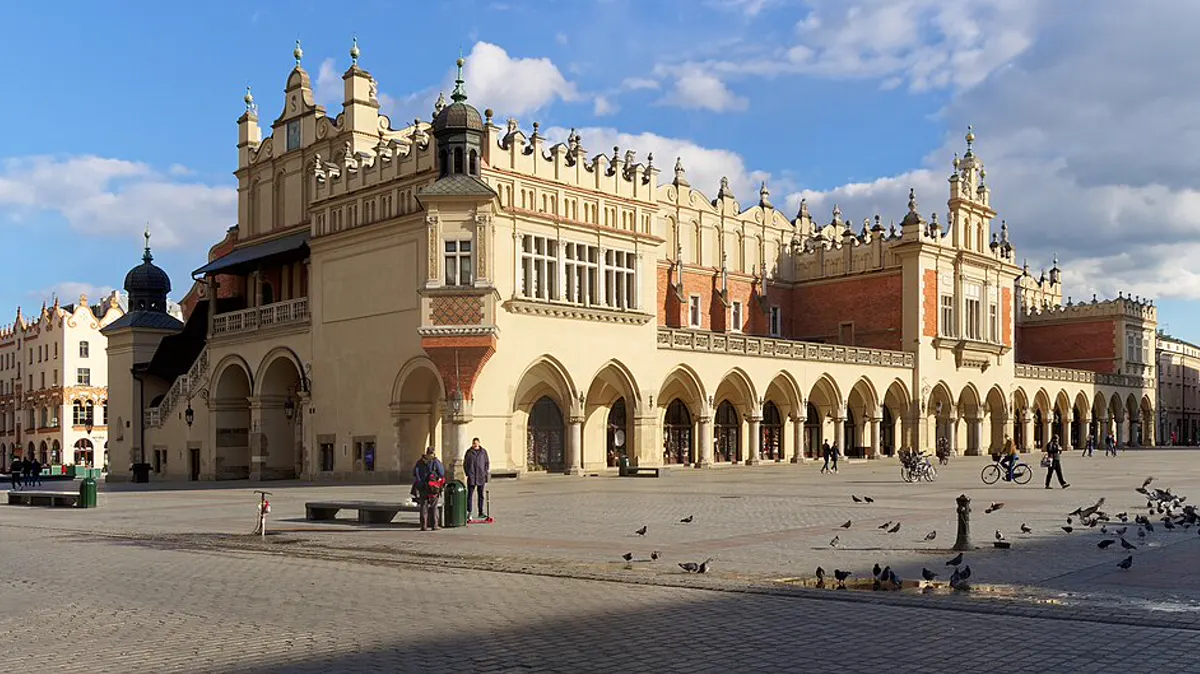
The Cloth Hall on Kraków's Main Market Square, the square where the szopka makers gather in December. Photo: Jakub Hałun (CC BY-SA 4.0), via Wikimedia Commons
Every year the makers gather on Kraków's Main Square on the first Thursday of December, which in 2026 is 3 December, and the city's Historical Museum then shows the cribs through the winter. It is a Polish Christmas tradition a visitor can see in person, and it fits neatly into a trip planned with Krakow in winter and the Krakow Christmas market.
Where can visitors experience Christmas in Poland?
The public side of Christmas happens on the market squares. The Polish Tourist Organisation highlights the lighting of the great tree on Kraków's Main Square, a procession of carol singers from folk groups who walk from the Barbican to the square, and in Wrocław a dwarf called Prezentuś whose arrival marks the start of the market. Which market suits which kind of trip is compared in Christmas markets in Poland, and gifts worth taking home in Polish souvenirs.
The private side, the supper itself, happens at home. Many restaurants and shops offer Christmas meals, but Study in Poland notes that Poles still prefer to cook family recipes, so a visitor's best chance of a seat at a Wigilia table is an invitation.
What is open in Poland over Christmas?
Very little. Christmas Eve has been a public holiday since 2025, so most shops close on 24, 25 and 26 December. The Polish Investment and Trade Agency says almost all businesses close for the whole Christmas period, that very few are open on the 26th, and that people often travel to their home towns a couple of days before Christmas, so book train tickets early.
If you are spending Christmas in Poland, book restaurants ahead, buy food before the 24th and check opening hours for anything you plan to visit. The full list of closed days, with the exceptions to the trading ban, is in public holidays in Poland. Epiphany on 6 January is another public holiday, when, the same agency notes, many Poles write the year and the initials K+M+B in chalk over their front doors.
Written by ViewPoland Editorial for ViewPoland, an independent English-language guide to Poland.
Published 25 October 2026.
Last updated 25 October 2026.
Frequently asked questions
Both, but the main family celebration is the Wigilia supper on the evening of 24 December. The 25th and 26th are spent with family too, and all three days are public holidays.
A thin Christmas wafer. Before the Wigilia supper everyone breaks a piece from each other's wafer and exchanges wishes for health and prosperity, and nothing is eaten until this is done.
The number is usually explained as the 12 apostles, and sometimes as the 12 months of the year. The dishes are meatless, with fish such as carp and herring alongside pierogi and poppy seed cake.
They are allowed to open, because the trading ban does not cover places whose main business is food and drink, but hours vary over the holidays. Book ahead and confirm with the restaurant.
The makers bring their szopki to the Main Square on the first Thursday of December, which in 2026 is 3 December. The Historical Museum of Kraków then displays the cribs through the winter.
We use Google Analytics to count visits. No ads, nothing sold. You can say no.