Thematic in Kraków
Krakow Old Town: What It Is and Where It Begins
Old Town, city centre and Main Market Square are three names people use for roughly the same place, which is why the question keeps being asked.
By ViewPoland Editorial
4 min read
Updated August 2026
The short answer
Krakow Old Town is the oval of streets inside the Planty, the green ring that replaced the medieval walls. The Main Market Square sits in the middle of it, so yes, the square is in the Old Town, and yes, the Old Town is the city centre. In Polish it is Stare Miasto.
The confusion is reasonable. Guidebooks, hotel listings and taxi drivers use Old Town, city centre and the Square almost interchangeably, and all three do point at the same small area. The useful mental picture is an oval about a kilometre long, wrapped in a park, with a castle hanging off its southern end. Whether the whole thing justifies a trip is answered in is Krakow worth visiting.
The Planty is the edge
Krakow pulled down its medieval fortifications in the nineteenth century and planted a park on the line they left. That park, the Planty, is now the cleanest boundary anyone has: inside it is the Old Town, outside it is not. You can walk the whole ring in well under an hour, which tells you how compact the historic core really is.
A fragment of the old defences survived the demolition, which is why the Barbican and St Florian's Gate still stand at the northern edge while the rest of the circuit is grass and trees.
The Main Market Square is the middle, not a separate place
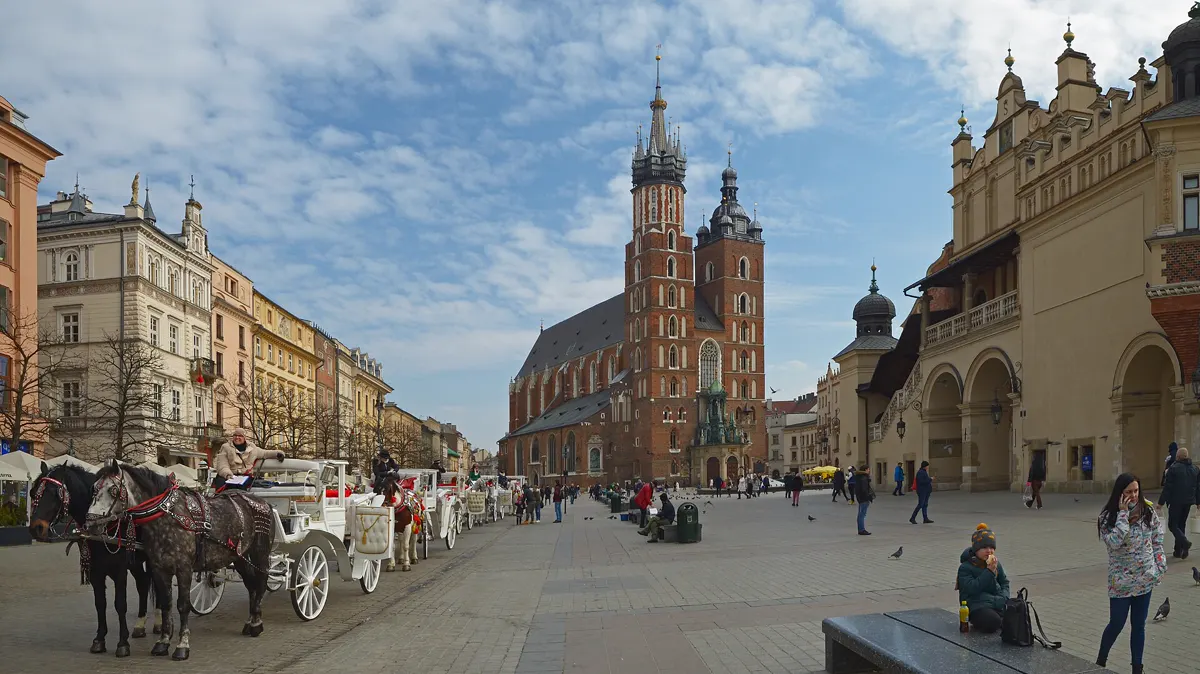
Rynek Główny, the Main Market Square, sits at the centre of the Old Town grid. UNESCO describes it as the largest market square of medieval Europe. The Cloth Hall runs down its middle, St Mary's Basilica stands on one corner, and almost every walking route in the city passes through it at some point.
So a hotel advertised as being on the Main Market Square is in the Old Town by definition. A hotel described as central may be just outside the Planty, which is a five-minute difference on foot and often a large difference in price. If you are wondering how to say any of these names out loud, see how to pronounce Krakow.
What UNESCO actually listed
The World Heritage listing is called the Historic Centre of Kraków and it was inscribed in 1978, in the first years of the list. It covers more than the Old Town alone: three separate urban units, namely the medieval chartered city, the Wawel Hill complex, and the town of Kazimierz including the Stradom suburb.
That is worth knowing because it explains why Kazimierz feels like a different town rather than a district. It was a different town, chartered in 1335 and only later absorbed into Krakow. The hill above it is where the kings were crowned, which is the subject of was Krakow the capital of Poland.
Wawel is attached, not inside
Wawel Hill sits at the southern tip of the Old Town, just outside the Planty ring but joined to it by a short walk down Grodzka or Kanonicza street. Treat it as part of the same visit rather than a separate expedition, and see our Wawel Castle visitor guide for how the ticketing works, because the hill is free to enter and the interiors are not.
How the pieces sit together
North to south, the walk runs Barbican, Floriańska street, Main Market Square, Grodzka street, Wawel. Carry on beyond the castle and you reach Kazimierz, then cross the river for Podgórze and the wartime ghetto. That single line covers most of what people come to Krakow to see, and the distances are shorter than the map suggests. We set them out in walking distances in Krakow.
Because the core is closed to cars, that line is walked, cycled or driven in one of the small electric vehicles allowed past the barriers. Our page on Krakow golf cart tours covers the four routes those vehicles run. What it is not is driven, which is the subject of driving and parking in Krakow.
Sources
UNESCO World Heritage Centre, Historic Centre of Kraków for the inscription, its date and the three urban units it covers, including the chartering of Kazimierz in 1335. City of Kraków for district boundaries.
Written by ViewPoland Editorial for ViewPoland, an independent English-language guide to Poland. Published 28 August 2026. Last updated 28 August 2026.
Frequently asked questions
Yes. Rynek Glowny sits at the centre of the Old Town, roughly in the middle of the oval formed by the Planty park. Every route through the historic core passes it.
In everyday use, yes. When someone in Krakow says the centre they normally mean the Old Town and the streets immediately around the Planty ring. Administratively the central district is larger, but no visitor needs that distinction.
Stare Miasto, which translates literally as Old Town. You will see it on street signs, tram stop names and hotel addresses, so it is worth recognising.
It is part of one. The listing is called the Historic Centre of Krakow, inscribed in 1978, and it covers the medieval city, Wawel Hill and the former town of Kazimierz rather than the Old Town alone.
Small. The Planty ring that encloses it is walkable in well under an hour, and crossing the Old Town from the Barbican in the north to Wawel in the south takes about fifteen minutes at a normal pace.
No. Kazimierz is a separate quarter to the south, chartered as its own town in 1335 and only later absorbed into Krakow. It is about twenty minutes on foot from the Main Market Square.