Thematic in Kraków
Do You Need Cash in Krakow? Where Cards Still Fail
You can spend three days in Krakow without touching a banknote, right up until the moment you cannot.
By ViewPoland Editorial
3 min read
Updated August 2026
The short answer
Krakow is close to cashless and cards work in almost every restaurant, shop, museum and taxi. Keep a small amount of zloty for market stalls, some milk bars, church donation boxes, tips and the occasional cloakroom. A few hundred zloty covers a short trip comfortably.
Poland moved to contactless early and thoroughly, and Krakow is one of the easiest cities in Europe to visit with a card and nothing else. The reason the question keeps coming up is that the places where cash still matters are exactly the places visitors go: the stalls in the Cloth Hall, the old milk bars, the seasonal markets.
Where cards work without thinking
Restaurants, cafes, bars, supermarkets, chain shops, museum ticket desks, pharmacies and taxis all take cards as a matter of course, and contactless is standard. Public transport takes a bank card tapped on the reader in the vehicle. Nobody will look at you strangely for paying for a coffee by card.
Where you will want zloty
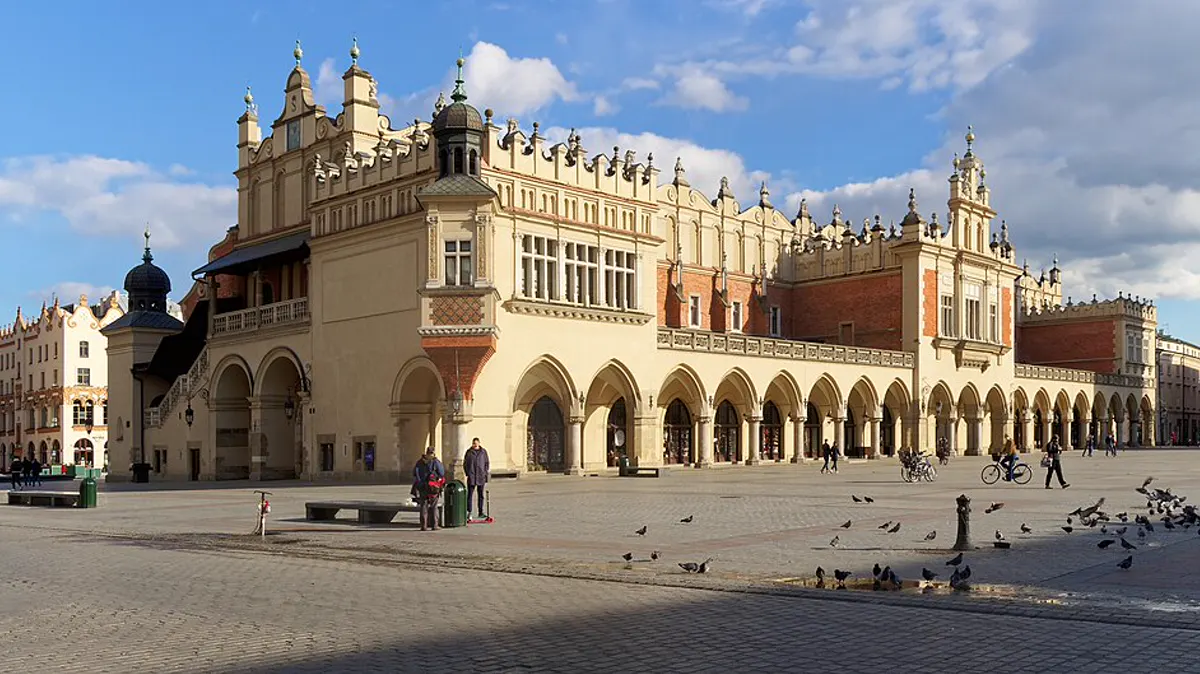
The market stalls under the Cloth Hall arcade are the classic case, and small independent traders in general. Some of the surviving milk bars, the cheap canteens that are a genuine part of the city's food culture, still run on cash. Church donation boxes and candle stands are cash by definition. Several of these places also keep their own opening days, listed in what is open on Sundays and Mondays. Cloakrooms in older venues sometimes are. And a tip left in coins is easier than a tip on a terminal.
The seasonal markets on the Main Market Square are worth singling out, because they concentrate small independent sellers in one place. Cards are increasingly accepted there, but not universally, which is why our page on the Krakow Christmas market tells you to arrive with notes.
Getting zloty without losing money
Withdraw from a bank ATM rather than one of the brightly coloured standalone machines aimed at tourists, and always decline the offer to be charged in your own currency. That offer, called dynamic currency conversion, lets the machine or terminal pick the exchange rate, and it never picks one in your favour. Choosing zloty means your own bank does the conversion instead.
The mechanics are the same across the country and we cover them in exchanging money in Poland and paying by card in Poland.
Do not pay in euro
Poland uses the zloty and has not adopted the euro. Some businesses in the tourist centre will accept euro notes, and the rate they use is theirs to choose. Treat a sign advertising that it takes euro as a warning rather than a convenience.
How much to carry
For a long weekend, a couple of hundred zloty in small notes covers everything cash-only that a visitor is likely to meet, and it fits the way the cash is actually spent, which is in small amounts. Large notes are awkward at exactly the stalls where you need them. There is no reason to carry more, because the card handles the expensive things.
Sources
Narodowy Bank Polski for the currency and reference exchange rates. City of Kraków for the municipal markets. Zarząd Transportu Publicznego for card payment on public transport. No amounts in zloty are quoted as prices here, only as an order of magnitude to carry.
Written by ViewPoland Editorial for ViewPoland, an independent English-language guide to Poland. Published 28 August 2026. Last updated 28 August 2026.
Frequently asked questions
Only a little. Cards work in almost every restaurant, shop, museum and taxi, but market stalls, some milk bars, church donation boxes and cloakrooms may want zloty. A couple of hundred zloty in small notes is enough for a short trip.
You need zloty. Poland has not adopted the euro. Some tourist businesses accept euro notes at a rate they set themselves, which is almost always worse than paying in the local currency.
Many do and some do not, because the stalls are run by independent traders rather than one operator. Bring notes so the answer stops mattering.
From an ATM belonging to a bank rather than a standalone machine in a tourist street. Always decline the machine's offer to charge you in your home currency, so that your own bank sets the exchange rate.
Yes. A contactless bank card tapped on the reader inside the vehicle works, as do the ticket apps. Machines on board generally take cards rather than coins.
Close to it, but not entirely. The everyday economy runs on cards while a thin layer of small traders, donations and tips still runs on cash, and that layer overlaps heavily with what visitors do.